Qwen3-Next: The Family of Models That's 10× Faster
Published on
The folks at Alibaba Qwen introduced the “Qwen3-Next” family of AI models, with a huge (and bold) focus on saving A LOT on both training and inference, which are some of the main bottlenecks.
The first thing to understand the innovation is what the “Mixture-of-Experts” architecture is. In very simplified terms, instead of activating the model’s entire neural network for each input prompt, the model has “neural sub-networks” that are experts in a certain topic, and a router activates the best sub-network(s) to answer your prompt. That lets you grow the models a lot without losing quality. It’s what all modern models (GPT-5, Gemini, Claude, Deepseek, etc.) already do.
It’s also worth mentioning the self-attention mechanism: it’s the one that pays attention to all the words in the sentence in parallel, and calculates how “relevant” the one currently being analyzed is in relation to the others.
The idea they used was that, instead of using the Transformer architecture with standard attention, they created a hybrid system that uses a faster attention mechanism (Gated DeltaNet) most of the time, and a Gated Attention only for the finer details. It’s a smart way to process long contexts without the computational cost exploding.
Like I said before, the Mixture-of-Experts idea isn’t exactly new, but they took it to the extreme. The model they released (open!! available on Hugging Face!!) is called “Qwen3-Next-80B-A3B”. Decoding the name, the “80B” means it’s a model with 80 billion parameters (considered an SLM, “Small Language Model”), but since it uses this Mixture-of-Experts architecture, only 3 billion (!!!) of them are activated on each pass.
On top of that, they introduced a native MTP (Multi-token prediction) mechanism, which lets the model predict and process several text tokens at once, instead of one at a time, increasing speed.
And so, in practice, this 80B version’s performance goes toe to toe with their flagship 235B model (almost 3x bigger) on several tasks, and it’s more than 10x faster on long contexts than models of similar size. That’s not a small gain, it’s really a step up for applications that need to “read” and interpret huge documents in real time.
They released 2 models in this family, the “Instruct” version (which starts answering immediately) and the “Thinking” version (a reasoning model, which “thinks” before starting to answer). The image below shows some benchmarks:
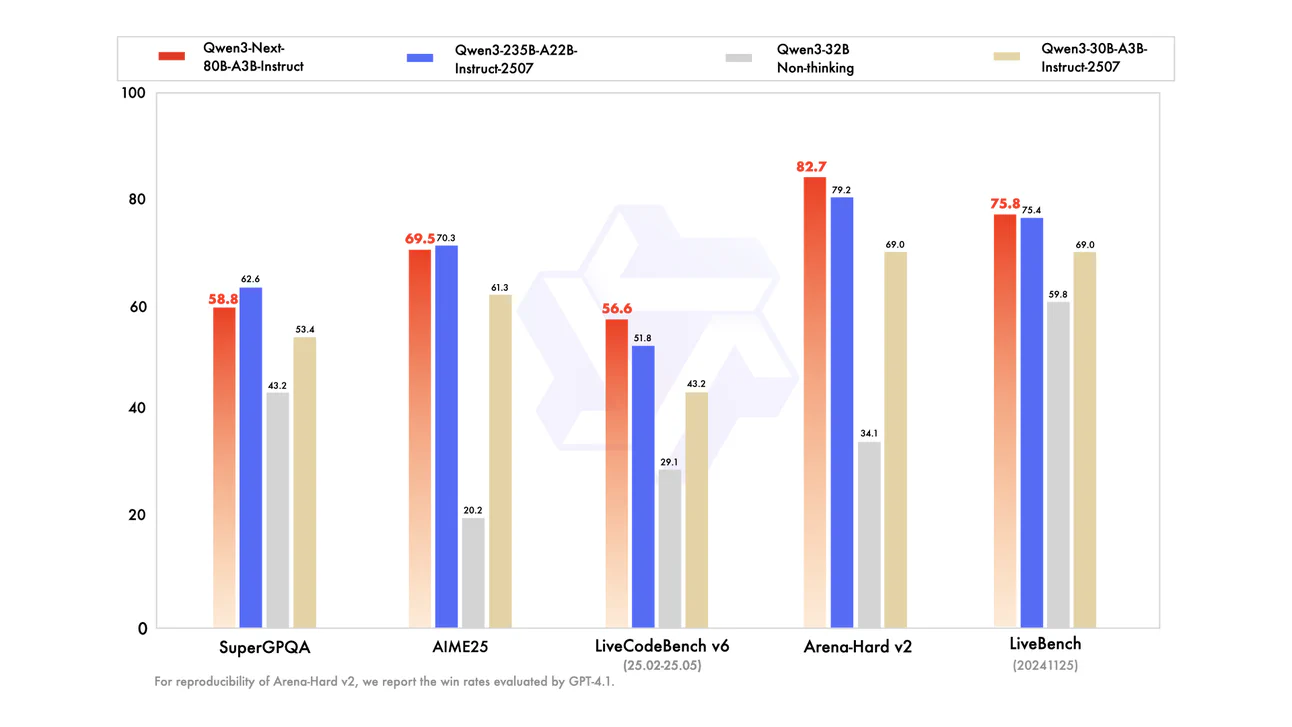
What I find most interesting here is the direction this points to. While part of the industry seems focused on the race to scale models to trillions of parameters, the Qwen team shows that innovating on the architecture’s own optimization can be a much more efficient shortcut.
I’m leaving below the links to the article about the release and to the models!