OpenAI Releases Two Open-Source Models!
Published on
A (long-awaited) bombshell in the AI world! @OpenAI (finally) joined the open-source (or rather, open-weight) model “fight” with the release of the “gpt-oss-120b” and “gpt-oss-20b” models.
And it’s no small thing. Since GPT-2, the company hadn’t released a language model with open weights, and now they’re kicking the door down, aiming straight at the competition with Meta (Llama), Mistral, and others. The models they released:
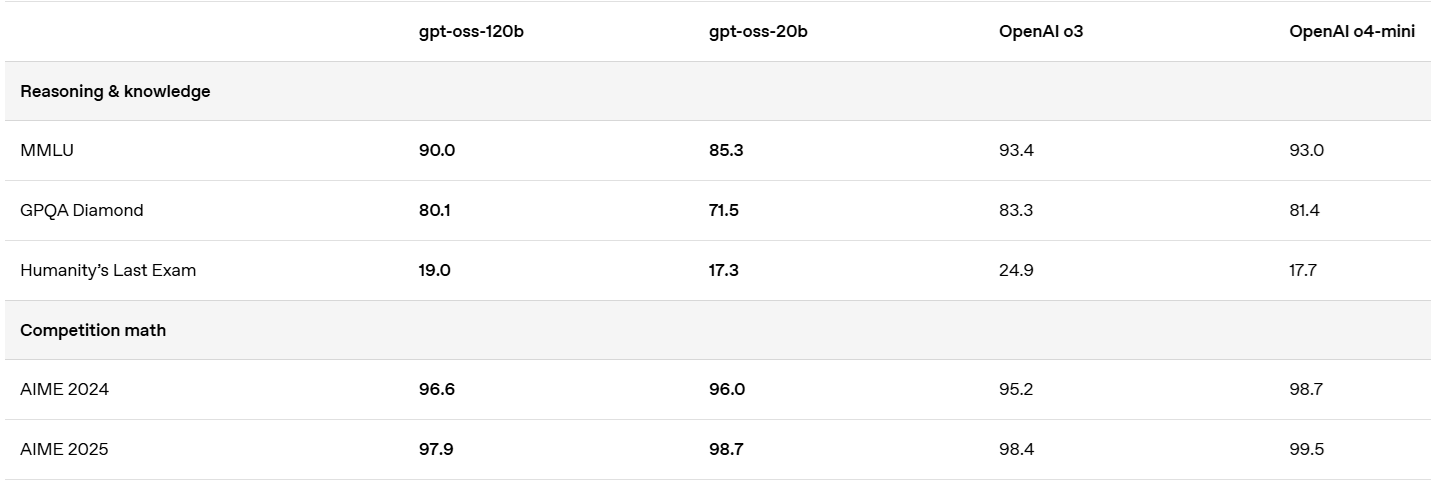
gpt-oss-120b: the bigger one, with 117 billion parameters (but only 5.1B active, thanks to the Mixture-of-Experts architecture), which according to the benchmarks goes toe to toe with o4-mini and even o3 on reasoning tasks, and even beats it in some health tests (HealthBench). Runs on a single 80GB GPU.
gpt-oss-20b: a smaller version, with 21 billion parameters (3.6B active), perfect for running locally or on devices with fewer resources. The most impressive part is that it takes up only 16GB of memory. Its performance is comparable to o4-mini’s.
But the real kicker (which caught me by surprise) was that these models were released under an Apache 2.0 license. For those who don’t know, it’s a super permissive license, meaning you can use, retrain, and distribute the models commercially with no problem at all. That’s a GIGANTIC differentiator.
Another big advantage is the training to work with AI agents. They were already designed for tasks that require tool use, like web search and running Python code.
On top of that, they’re reasoning models and give us full access to the model’s Chain-of-Thought, which is excellent for debugging and for building trust in the result. OpenAI recommends not showing that directly to the end user, but for developers, it’s gold.
Besides full fine-tuning, you can adjust the model’s “reasoning effort” (low, medium, or high), optimizing the tradeoff between performance and latency.
Another point I found really interesting was the concern for safety. They got ahead of the criticism about the risks of open models and ran “malicious fine-tuning” tests to see how dangerous the model could become. They also launched a Red Teaming challenge with $500 thousand in prizes for the community to help find flaws. Nice initiative!
In practice, it’s a huge move by OpenAI to not lose ground in the open-source ecosystem, offering very high-performance models to the community. The fight for the best open model, which was already good, is now going to catch fire.
They’ve already closed partnerships with the whole open-source ecosystem (Hugging Face, Ollama, vLLM, Microsoft, NVIDIA, etc.) to make sure the models are easy to use from day one. I already downloaded the 20b one to run locally here (though my laptop isn’t really up for it).
I’m leaving the link to the full article and to the models’ model card below, in the comments.
Link to the models’ model card