OpenAI Publishes 722 Math Solutions Generated by a New Secret AI
Published on
OpenAI dropped a math announcement yesterday without the usual hype, but delivered something gigantic.
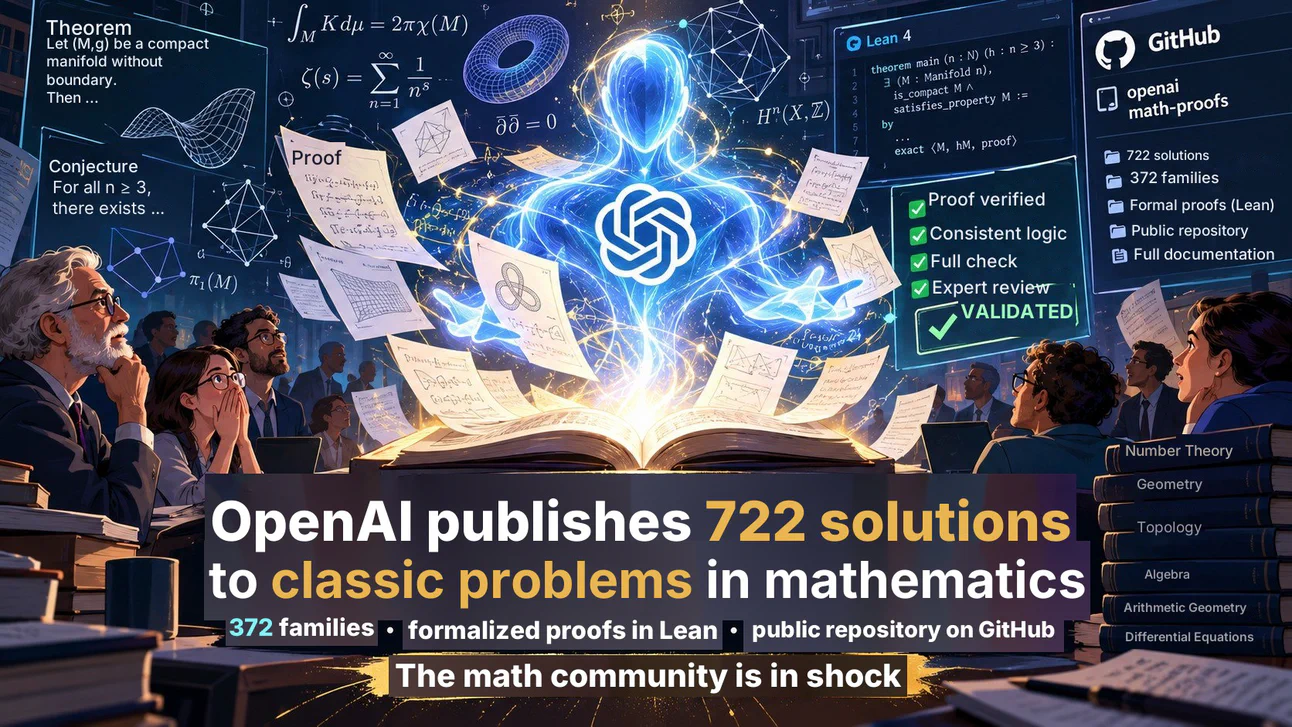
They published 722 solutions to classic math problems, organized into 372 families, all generated by an internal frontier model (still unnamed). They released everything in a public GitHub repo (link below).
After all the controversy over their announcement about solving the Navier-Stokes millennium problem, this time they were more careful. They consulted the “Advisory Group on Mathematics and Artificial Intelligence” to define good disclosure practices. This time, the solutions came with review protocols, paper citations, formalizations of several proofs in Lean (that language that lets you mathematically check a proof by computer), summaries of the model’s reasoning, and estimates of how much all of this cost.
According to them, the average of these proofs consumed the equivalent of 3 hours of GPT Pro. Remember that in the Navier-Stokes case, it had been an investment of millions of dollars, with 10 thousand agents running for 88 hours.
And now, the math community folks are losing their minds (in a good way). Some standout comments I saw:
Prof. Alex Kontorovich said that them solving the Quasi-Riemann Hypothesis (maybe the most relevant of this batch) is “insane” and that, if a human had gotten there, they’d win a Fields Medal on the spot.
Levent Alpöge, a mathematician who works at competitor Anthropic and one of the key players in the Navier-Stokes drama, said he regrets not having tried using AI to solve some of these, and that this is “the most significant moment in the history of mathematics”.
And some that caught my attention, from mathematicians talking about a “mathematical intuition” in this model (and not just brute force):
Jake Boggan said he had studied one of the problems (Barnette’s Conjecture) years ago and again recently with Claude Fable, and hadn’t gotten anywhere close, but that this new model managed to follow a different path and had an “aha” moment on a complex strategy he saw for the first time.
Joshua Zelinsky said that “it doesn’t look like the method follows a direction used in the prior literature, as far as I know… it goes way beyond simply leveraging existing methods or noticing connections between different problems” and that “it looks like the AI is, somehow, inventing new techniques on its own”.
If it were just OpenAI dropping a huge wall of nice results on GitHub, we could suspect it’s just a marketing move. But since there was prior consultation with an independent academic group, formalization in Lean, and the math community vouching for it, it seems MUCH more real to me than fear-mongering or empty advertising.
We hope this model gets released soon! Here are the links to the repository and the official announcement:
- Announcement link: https://openai.com/index/sharing-ai-progress-in-mathematics/
- Repository link: https://github.com/openai/math