New Mercury 2: a super fast diffusion model for text
Published on
The company Inception launched Mercury 2, a reasoning-focused LLM built 100% on diffusion models.
To understand what that means, we need to remember how things work today. Practically all the big models we use (GPTs, Claude, Gemini) are autoregressive. Basically, they generate text sequentially, predicting and “spitting out” one token at a time, from left to right, kind of like me or you typing one word after another.
Even though this works very well with reasoning (as we’ve seen benchmark after benchmark being broken), it creates a natural speed bottleneck, because you need to wait for the previous word to be ready before generating the next one.
What Mercury 2 does is apply the concept of diffusion, which is commonly used in image models like Nano Banana or Midjourney, only for text!
With images, it works like this: the model starts with noise (like the static on your old TV), and step by step it refines it until it reaches the perfect picture of the “astronaut cat” you asked for in the prompt. For text, instead of generating token by token in sequence, it also starts with a whole draft full of “noise” and refines the entire answer in parallel, simultaneously, in a few iterations. It’s as if it saw everything at once and kept changing the words it thought were wrong.
And the results are absurd: it can generate 1009 tokens per second (no, I didn’t mistype that). Just for context, the fastest models from the big companies, like Claude 4.5 Haiku and GPT-5.2 Mini, generate around 70 to 90 tokens/second.
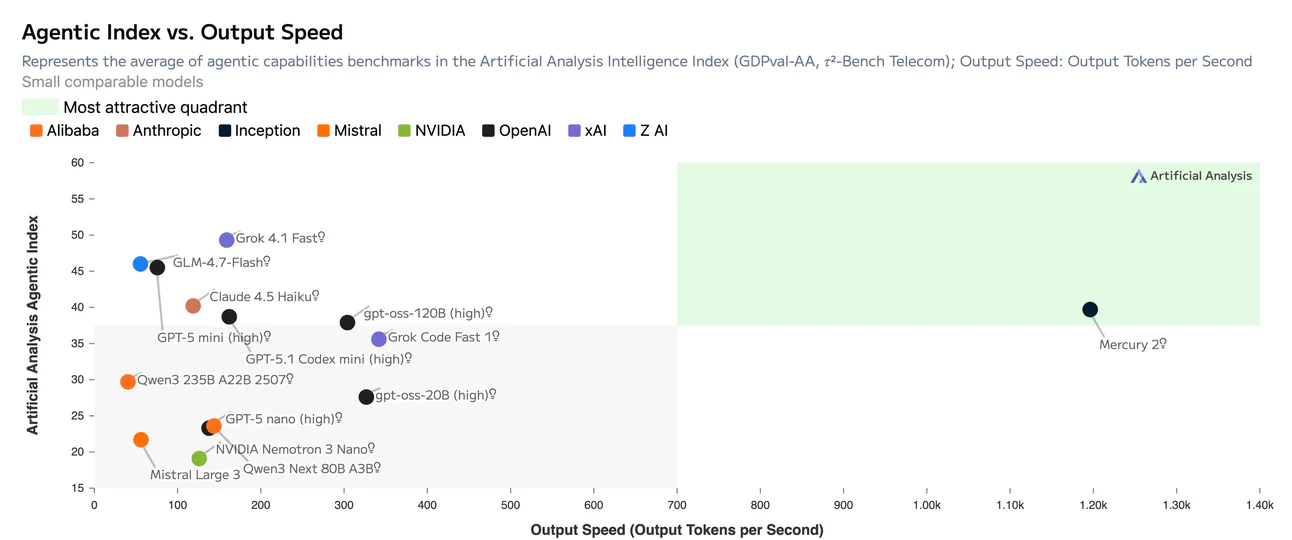
Below is the video so you can understand how absurdly fast it runs:
But of course, being fast wouldn’t be enough if it performed badly. In the benchmarks they published, it nailed 91.1% on the AIME 2025 math benchmark (above Gemini 3 Flash) and 74% on GPQA Diamond, the PhD-level questions (above Claude 4.5 Haiku). In other words, it delivers quality very competitive with the “fast” models from the top companies, but at a speed WAY above.
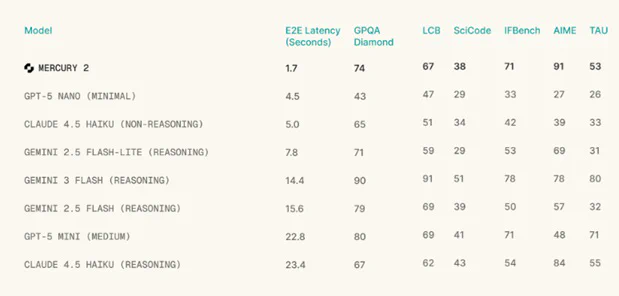
It costs USD 25 cents per 1 million input tokens and USD 75 cents per 1 million output tokens.
Worth remembering that Inception isn’t alone in testing this. Google DeepMind itself is investing in research on diffusion models for text, and in fact, we had a fantastic chat about it on IA Sob Controle with João Gabriel Oliveira, a Brazilian DeepMind researcher who worked precisely on Gemini Diffusion, released a few months ago. If you haven’t listened, I highly recommend it!
For those who’ve been following me here for a while, you know I have a soft spot for new architectures, and this diffusion for text thing seems so strange to me that it actually works that it attracts me more than the others. If you test it in your agent, leave a comment here!