Kimi K3: the new DeepSeek moment for Chinese AI
Published on
We might be living through a new “DeepSeek moment” in the AI world.
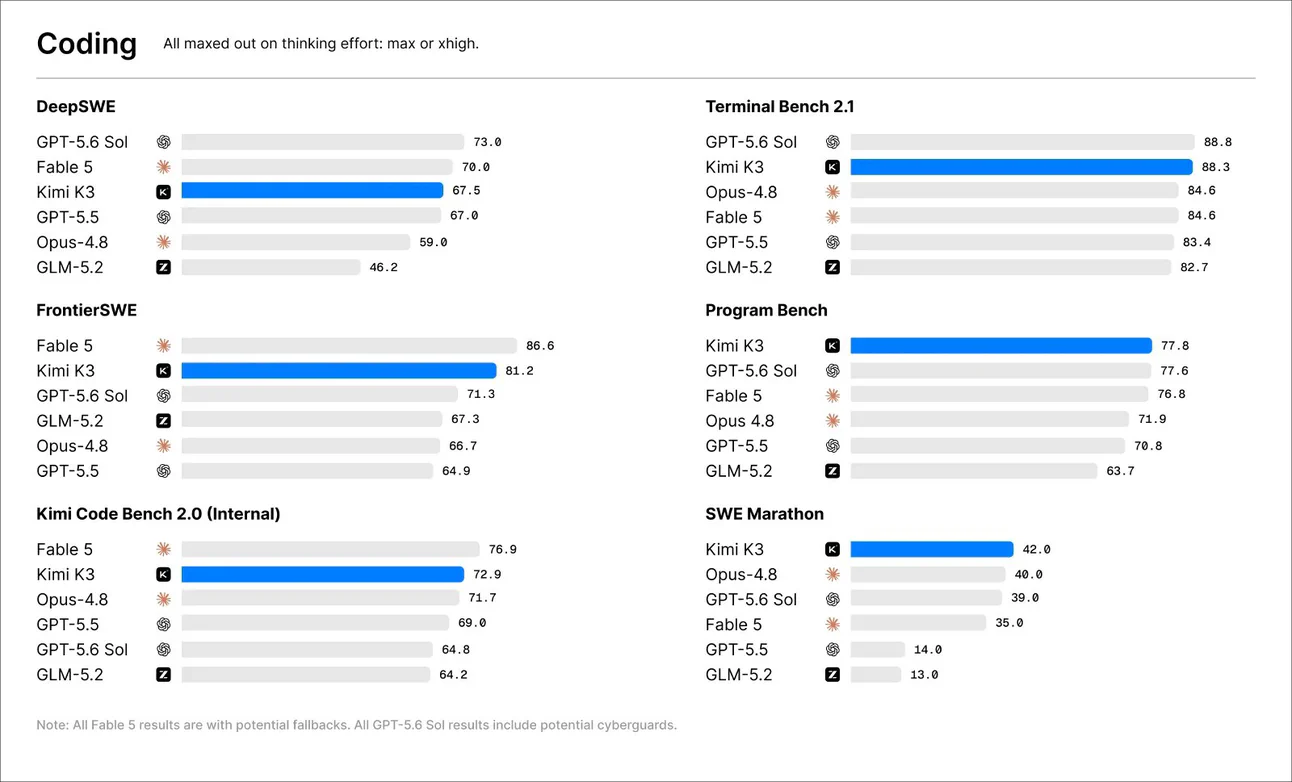
Every time China drops a strong open model, it’s the same scene: Silicon Valley trembles, semiconductor stocks fall and everybody in my feed starts comparing benchmark screenshots. It happened with DeepSeek last year, and again this week with the launch of Kimi K3.
Moonshot AI (the same company behind Kimi K2.6) released what is officially the largest open weights model in the world so far. It has an absurd 2.8 TRILLION PARAMETERS (in that Mixture-of-Experts architecture, of course) and a context window of 1 million tokens.
It’s the first open model to enter the 3-trillion-parameter class, something we had only seen (or rather, assumed) in closed American models until now.
And its performance is the reason for all this buzz. Moonshot itself admits that K3 still sits behind Claude Fable 5 and GPT-5.6 Sol, but says it beat every other model tested (including Opus 4.8). And it can even beat those two top dogs on several benchmarks. There were also independent evaluations, from Artificial Analysis and Arena, that put K3 as the #1 in the world for front-end and 3rd overall.
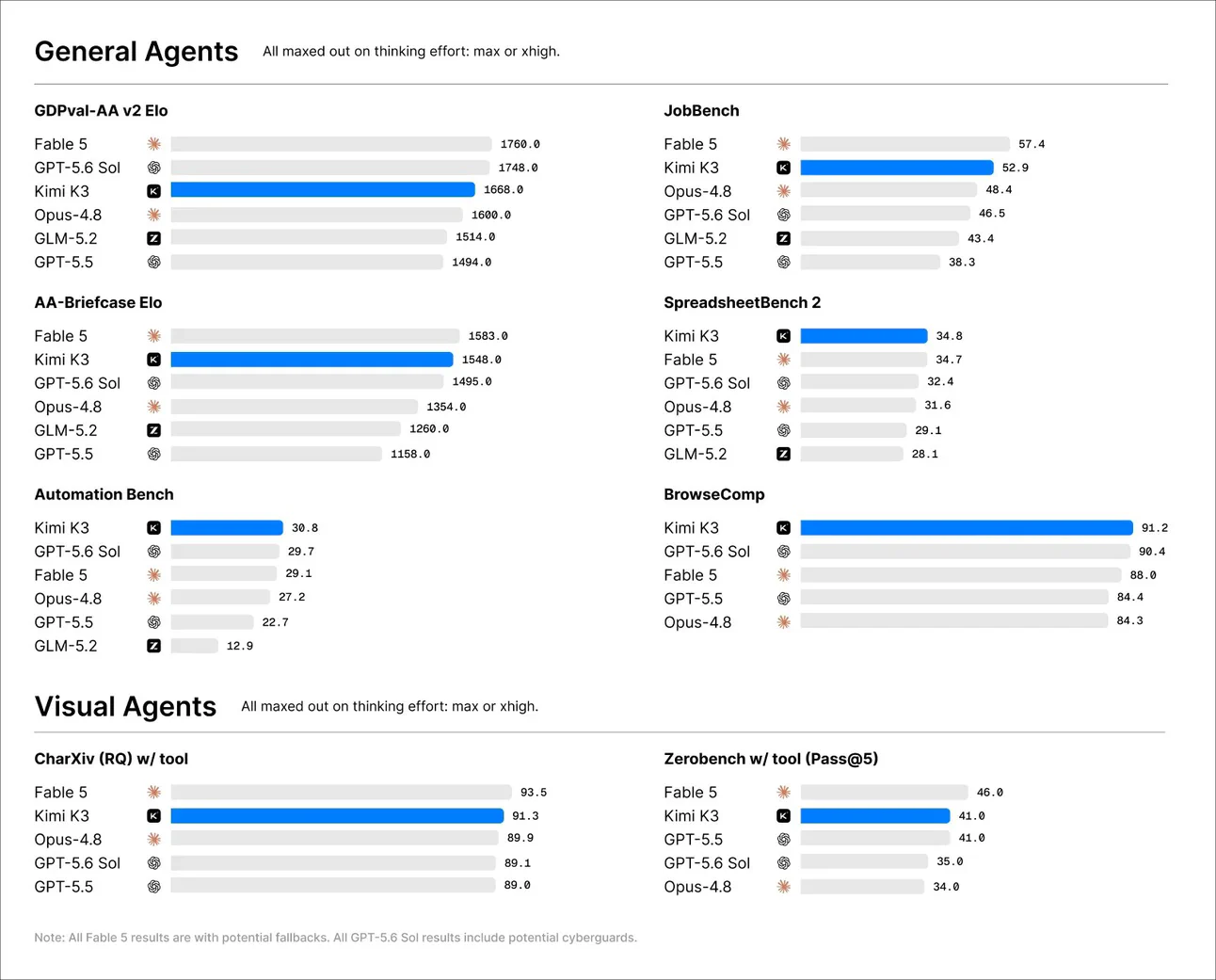
The CEO of Arena said this might be the biggest release of the year, with Chinese open models beating American models for the first time this clearly (which was my bet for 2026 on the Christmas episode of IA Sob Controle with the “AI Avengers” 😎).
In practice, the people who decide what goes into production don’t care as much about a benchmark scoreboard as they care about the bill at the end of the month, like price per token, latency and whether you can run it on your own infrastructure without depending on a third-party API. If K3 delivers performance close to Claude and GPT for a fraction of the cost (and being open), a lot of companies are going to rethink whether it’s worth continuing to pay for the expensive plans. It’s that cold calculation (not the pretty benchmark) that usually decides a stack migration.
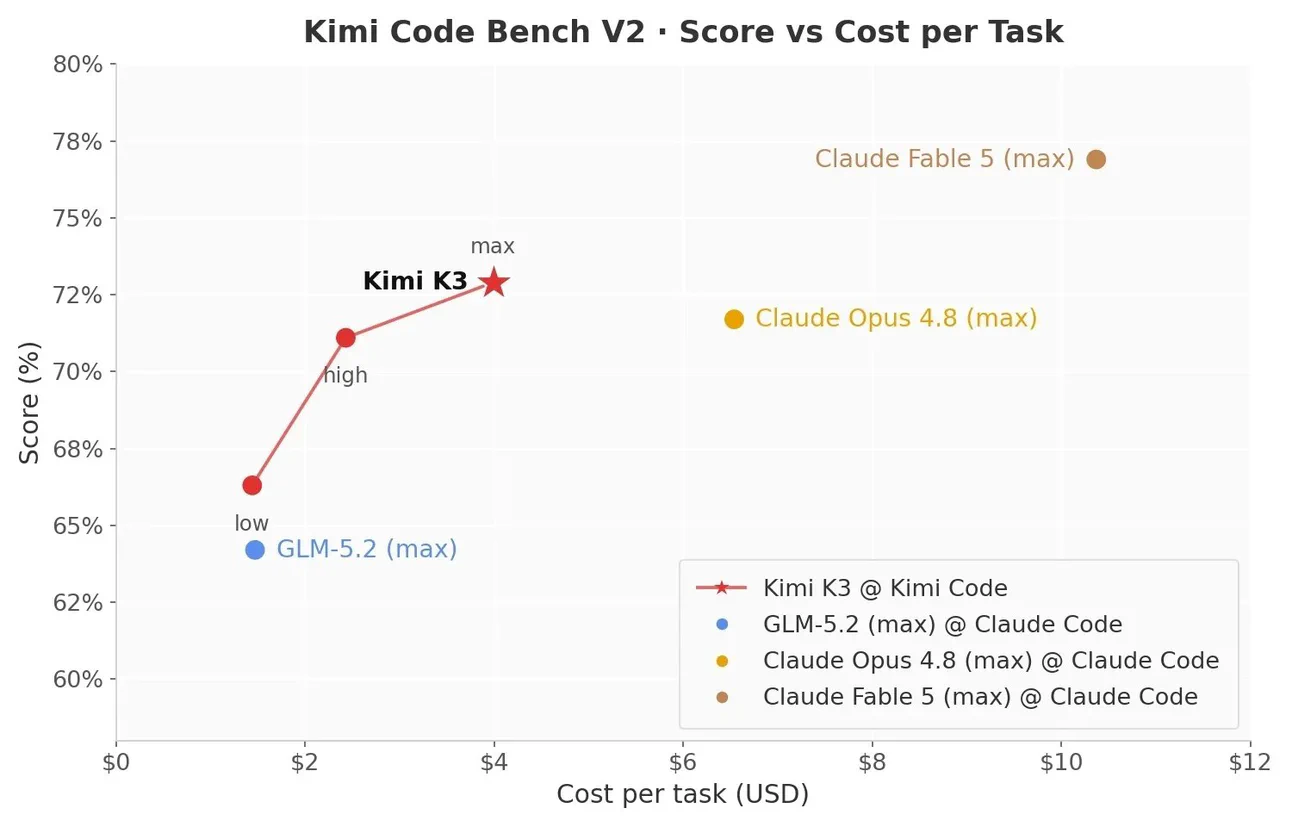
And it’s not like it’s dirt cheap. On the API, it’s coming out at $15 per 1M output tokens, which is the price of Claude Sonnet 5. But Opus and Sol cost $30 and Fable costs $50. So it can be worth it (a LOT).
A recurring criticism I saw is that it’s way too verbose in its reasoning. Like, it often takes a long time to answer or gets lost, which is something that could be fixed in post-training in a K3.1 version.
You can already use the model on Kimi’s website and API, but the full weights will only be released on the 27th, so it’s still too early to know how it really behaves outside the company’s controlled tests (always good to remember that).
But the backdrop here is bigger than just a new model. It’s one more proof that the “gap” of 6 to 12 months the US supposedly had over China is getting shorter and shorter, and that the open source path has everything it needs to be MUCH more competitive than the closed American labs would like.