Invisible Watermark in Claude
Published on
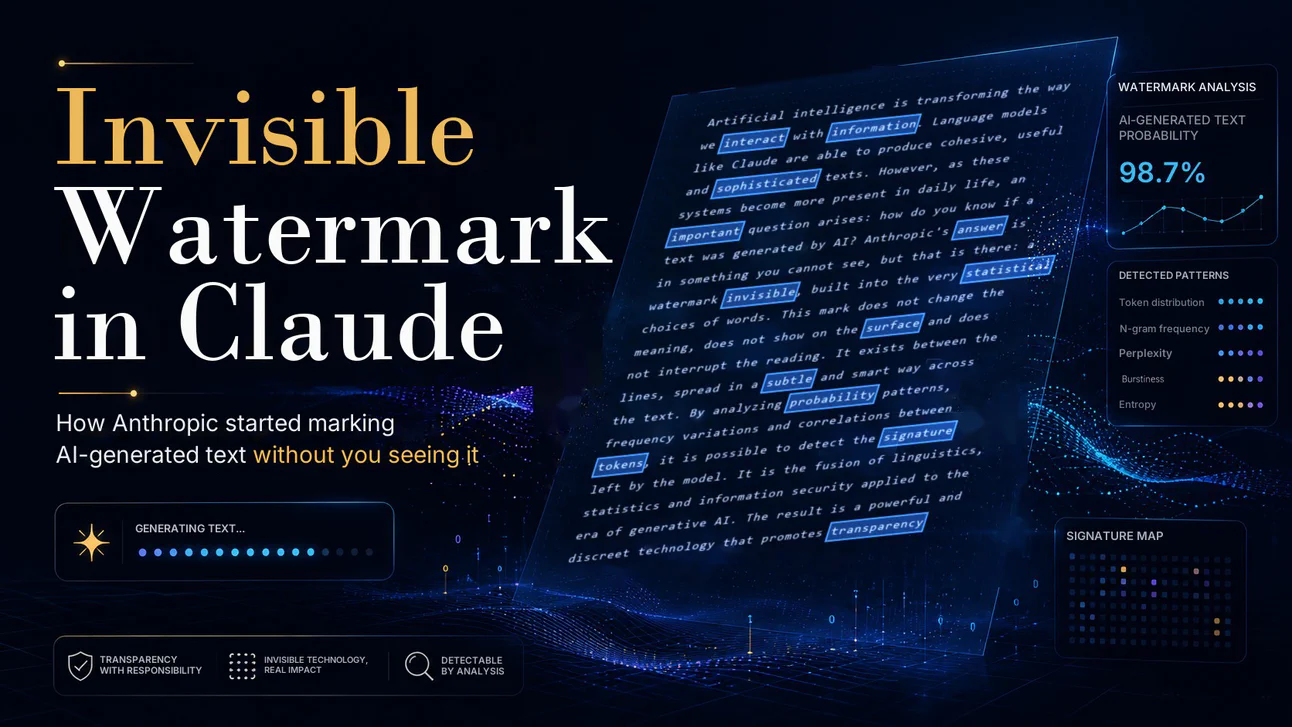
Starting August 2, 2026, Anthropic began inserting an invisible watermark into every single piece of text generated by Claude, one that can statistically indicate it was generated by AI.
Unlike what a lot of people might think at first, this has nothing to do with invisible characters or metadata (which could easily be stripped out). It’s built into the choice of the words themselves. And it will apply to all text generated by Claude models released from that date on.
I’m going to explain exactly what changed, why it changed and (the tastiest part) how this watermark works under the hood, for anyone who wants to go deeper.
Shall we?
Why Anthropic decided to do this now
The short answer: the EU AI Act. More specifically, its Article 50(2), which deals with transparency of AI-generated content. In July 2026, Anthropic signed, along with around 190 signatories (other AI companies included), the EU’s Code of Practice on Transparency of AI-Generated Content. This code requires AI system providers to “mark” the content generated by their models in some way, so that other systems can identify that origin.
The EU rule came into force on August 2, 2026, and that’s exactly the cutoff date Anthropic used: every Claude model released from that day on already embeds the watermark by default, with no option to turn it off. Older models (the ones already on the market before that) will gain the same capability gradually, with a deadline of December 2, 2026 to be compliant.
According to Anthropic itself, images, SVG files, PNGs and other media formats generated by Claude will also carry what they call “signed provenance metadata”, following the C2PA standard (the same one other tech companies use to flag synthetic content). The difference is that, for files, you can see that metadata if you know where to look. In text, the mark is completely invisible to the naked eye.
Since there’s still no reliable way to apply this rule only to European users, they decided to simply turn the watermark on for everyone, anywhere on the planet. In other words, if you use Claude in Brazil, your answer is marked too.
What exactly a text watermark is
This concept of watermarking AI-generated text is a technique that subtly alters a language model’s word choices, in a way that doesn’t change the meaning of the text but creates a statistical pattern that can be detected by whoever has the right “key”.
To understand this, it’s worth quickly recalling how an LLM writes a text. It doesn’t think up the whole sentence at once.
First, the model receives everything that’s been written before (the context) and, based on that, tries to predict the next token (sub-word) with the highest probability of continuing the text. It calculates a bunch of candidate tokens, and each one gets a probability of being the next. The model picks one of them, usually the most likely, and that token is added to the text. The process repeats, token by token, until the answer is finished.
Thinking of a practical example:
The weather today is very cold and…
The next token will almost certainly be something like “cloudy”, “gray” or “damp”. It’s very unlikely to be “Gretchen” or “NVIDIA”, because those tokens have a probability close to zero there. It’s basically a game of what the most likely next word is, repeated hundreds of times until the answer is done.
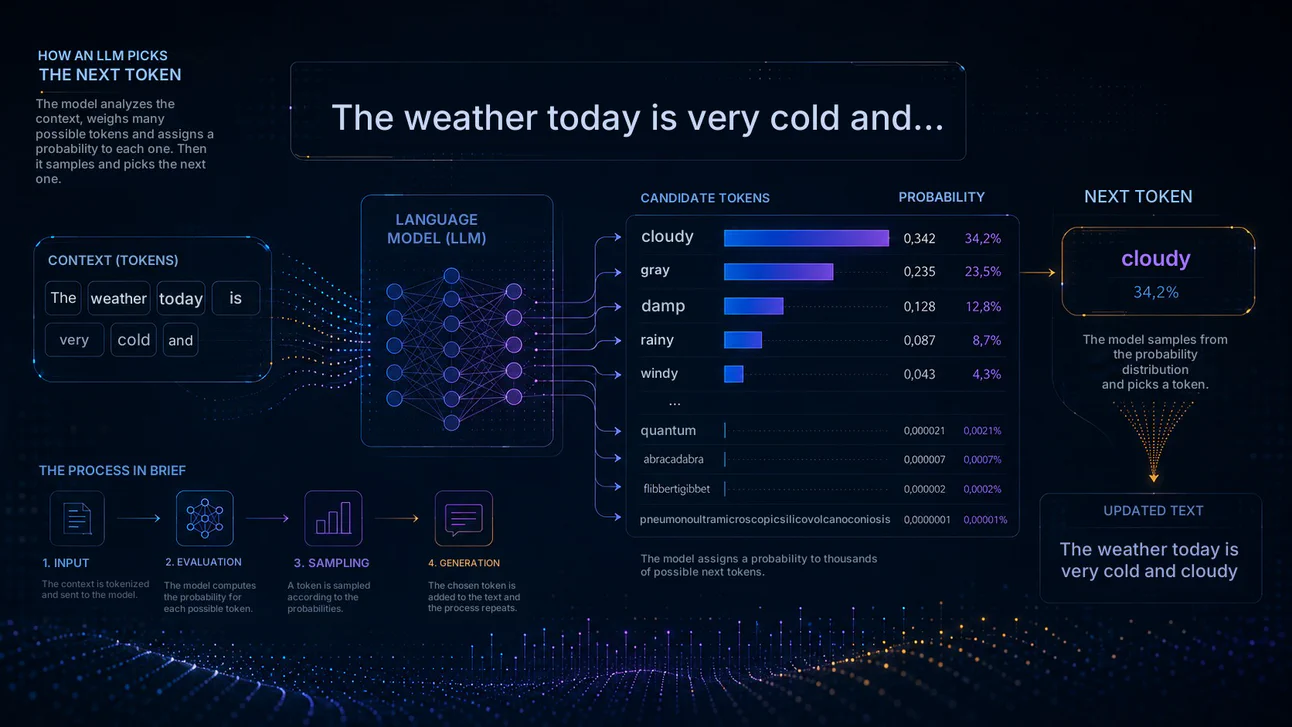
But the vast majority of the time, there isn’t one single right word. There are several words that are “tied” or very close in probability. If we’re in a bad-weather context, the model saying “Yesterday it rained a lot”, “Yesterday it rained heavily” or “Yesterday it rained significantly” kind of comes out the same, and they’re all perfectly reasonable choices. It’s exactly in this technical tie that the watermark comes into play.
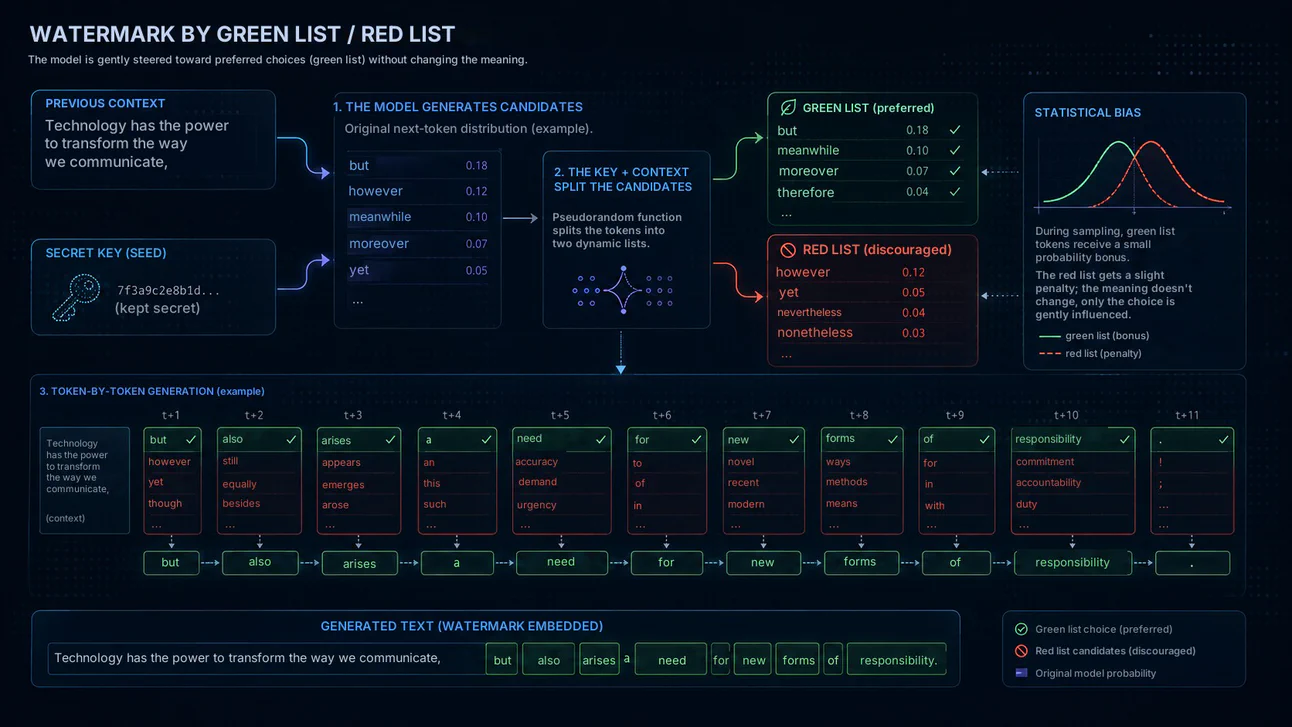
Instead of drawing the next word with an ordinary random number generator (as the model normally would, to give that natural variation in its answers), the system uses a secret key combined with the words that came before to decide, in a pseudorandom but reproducible way, which of the “tied” options gets picked.
Applied just a few times, this makes no difference, just like when you flip a coin: it’s quite possible to get 4 heads and only 1 tails. But the more you flip it, the closer the result gets to 50% heads and 50% tails (unless it’s a loaded coin). The same logic applies to text generated by Claude: for a single sentence, it’s practically impossible to say whether it’s loaded (that is, whether it was generated by AI or not), but over a whole longer text, a pattern of choices starts to show up that looks random to an ordinary reader but is, in reality, a “loaded” sequence, determined by that key. And whoever has the key can run the math backwards and check whether the chosen tokens/words are closer to 50-50, or closer to something like 65-35. The “randomness” still looks random, but it has a controlled origin.
The research behind it: Kirchenbauer’s “green list” method
This idea wasn’t born at Anthropic. Academia has been developing it for a few years now, and one of the most cited works (and probably the kickoff of this whole wave) is the paper A Watermark for Large Language Models, by John Kirchenbauer and colleagues, released in 2023.
The central idea of that paper is simple to explain with an analogy. Imagine that, before the model picks the next word, a “key” (derived from the previous word) splits the whole vocabulary into two groups: a green list (with tokens like “heavily” and “significantly”) and a red list (with tokens like “a lot” and “abundantly”). The model then gets a little statistical nudge to prefer words from the green list, whenever that doesn’t hurt the quality of the text too much. Since this process repeats at every word, and the split between green and red list changes dynamically token by token (based on the previous context), the result is a text that, without the mark, would have a normal distribution of green and red list words, but that, with the mark, has a statistically higher proportion of “green” words.
To detect whether a text was generated with that mark, all you have to do is run the same green/red split algorithm over the suspect text and count how many words landed in the green list. If the proportion is much higher than what pure chance would predict, it’s a strong sign that the text came from a model with that watermark turned on.
SynthID-Text: the method Anthropic says it uses as a base
Now, the most interesting piece of the puzzle: according to Anthropic itself, their implementation is based on the SynthID-Text approach, created by Google DeepMind and published in the journal Nature in 2024. This method has been used since 2023 to mark text generated by Gemini, and it works with logic similar to Kirchenbauer’s, but more refined.
Instead of simply splitting the vocabulary into two fixed lists, SynthID-Text uses what the researchers call “random scoring functions”, tied to a cryptographic key and to the context of previous tokens. In practice, it modifies the next-token sampling process itself: instead of randomly drawing among the most likely options (as the model would in a regular generation), it uses a source of randomness derived from the secret key. The end result has practically identical text quality to unmarked text (which is, by the way, one of the method’s great merits), but it carries a subtle statistical signature spread throughout the whole answer.
The advantage of these techniques is that there’s no hidden character, no hidden tag, nothing that can be easily removed. It’s the statistical choice of words itself that carries the information. This also explains why the mark survives things like copying and pasting the text into another program, or even making small edits to it. Since the mark is distributed across hundreds of word choices, removing or editing a small stretch doesn’t erase the pattern in the parts that remain.
When the mark “fails”
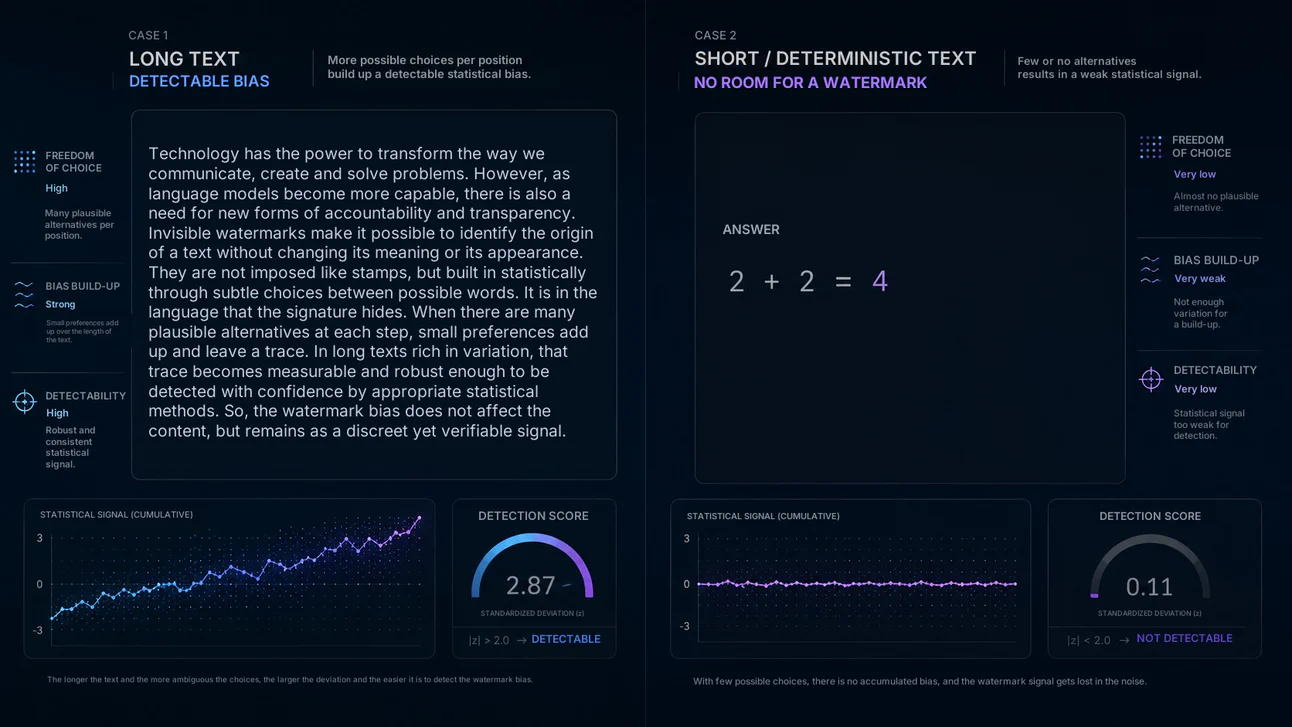
A point Anthropic itself highlighted, and that I think is essential so you don’t believe this technology is infallible, is that in stretches where there’s only one right answer, the system has no way to “push” the model toward another choice without simply making the answer wrong. The example they gave was:
As soon as the model writes “2 + 2 =”, there’s a very clear choice for the next token (if the model is completing the sum, there’s no answer as good as “4”; if it’s talking about George Orwell’s 1984, there’s no answer as good as “5”).
In other words: in those cases the model has no equally good alternative to pick on behalf of the watermark. Forcing a “less obvious” choice there would break the quality of the answer, so the watermarking simply sits out and lets the most likely token through.
That’s precisely why the mark works better on longer texts with a lot of natural lexical ambiguity (like an e-mail, a summary, a creative text), and gets weaker or disappears completely in very short or very technical answers, where practically every word is “mandatory”. A watermark detector, therefore, doesn’t give a binary “it’s AI” or “it’s not AI” answer. It calculates a probability, based on how many tokens in the text showed that statistical bias.
What a watermark proves (and what it does NOT prove)
Here lives a gigantic confusion that has already shown up a lot in the coverage of the subject, and that I think it’s important to make very clear. Anthropic was direct in stating that the existence of a mark in the text is not entirely conclusive that the content was entirely generated by AI, only that it was processed by a Claude model.
So, imagine these scenarios:
- You write a whole paragraph on your own and just ask Claude to check the grammar. The final text will carry the watermark.
- You ask Claude to translate a text of yours into another language. Since every word of the translation was chosen by the model, the translated text carries the mark, even if the original idea was 100% yours.
- A multilingual student uses Claude just to make their English clearer. The text carries the mark.
- Someone asks to reorganize an already finished paragraph. The text carries the mark.
All of these cases, completely different in terms of “how much human work” is in there, leave exactly the same mark. That’s why a column published in Forbes summed up the problem well: the mark proves Claude was used, not who wrote what. Treating AI assistance, AI generation and academic dishonesty as synonyms is a mistake, and the mark, by itself, doesn’t solve that confusion. It just delivers a result that looks scientific but can hide the same old problem.
And the reverse is also true: the absence of a detected mark doesn’t mean the content wasn’t generated or processed by AI. A screenshot of a generated image, a format conversion, or simply running the text through another company’s model that doesn’t have this system (or that has its own) can “clean” the mark.
I imagine this will be the most used approach from now on: you generate the text in Claude, but pass it through GPT, Gemini or Grok, asking it to rewrite it keeping the same central idea and examples, but using synonyms. That alone would be enough to partially or completely ruin that statistical validation.
As you’d expect, the news generated plenty of discussion. According to a report by TechCrunch, a considerable part of the irritation comes precisely from people worried about getting “caught” using AI for tasks that, technically, should be done (or at least signed) by humans, like students who ask to reorganize a paragraph, journalists who paste AI-generated summaries straight into the final text, or copywriters who ask for synonyms to get past a creative block.
Some people also noticed an interesting irony: AI companies that trained their models on mountains of human-made content (a lot of it without explicit consent) are now applying a layer of traceability over what humans are generating with them.
Conclusion
Honestly, despite the natural discomfort, I think it was only a matter of time until this arrived. For images and videos it ends up being something positive and desirable, but for text, I’m still unsure about its real usefulness. Either way, it’s good to know that this statistical fingerprint now exists, and understanding how the mark is created helps us understand both what it really proves and the (very real) limits of what it promises to solve.
Happy studying!