Harness: the word of 2026 in AI
Published on
I was reading a really cool article by Sebastian Raschka (one of the guys who understands AI the best right now), and decided to bring a summary of it here for you, because it’s something that really makes sense to spread and not everybody knows it.
I think everybody already understands today that LLMs like Claude Opus, GPT-5.5 and Gemini 3.1 Pro are excellent at programming. But for those who aren’t really in this field (or even for those who are), there might be some doubt about why tools like Claude Code, Codex or Cursor seem to be MUCH better at creating and structuring code than the raw models.
Well, that’s because of the “harness”. This is maybe the word of 2026 in AI (like “Agents” was for 2025) and, translated, it means something like a horse’s harness or reins. But in this context, they’re the reins that control and try to get the best out of a model to turn it into the best possible coding agent, with a whole bunch of engineering around it.
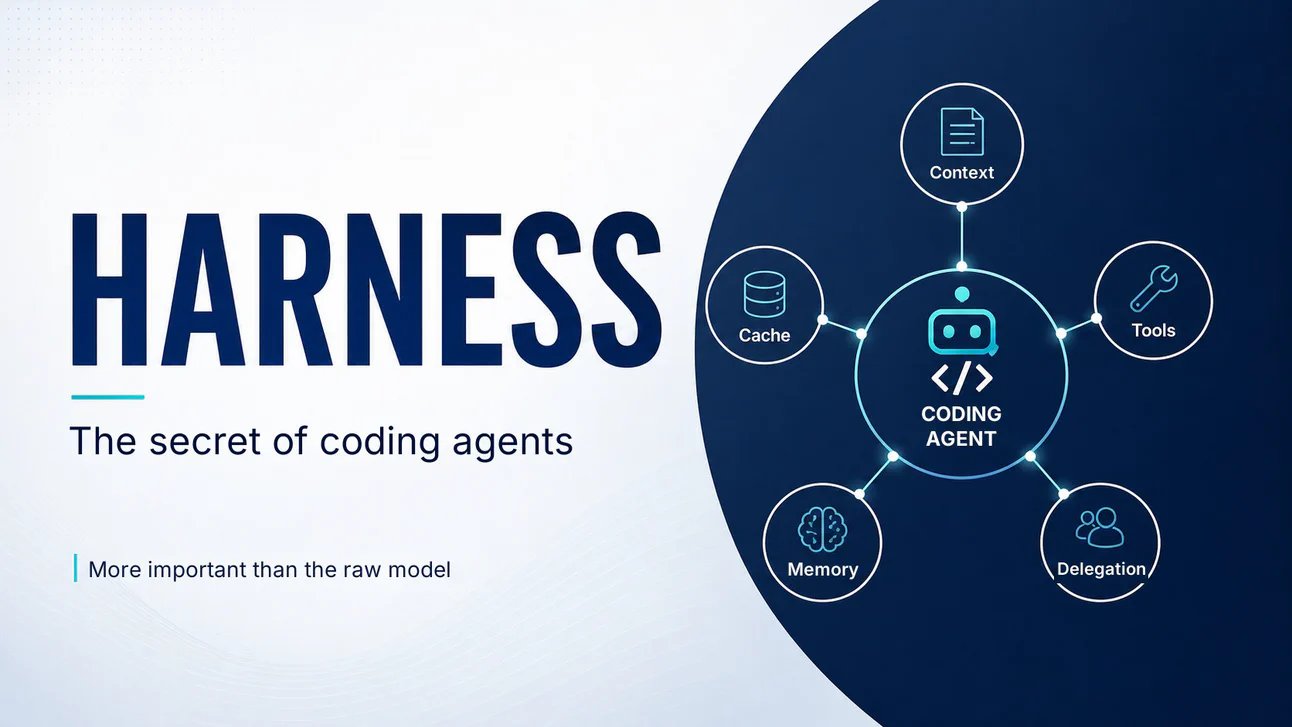
Some pillars of a “harness” are:
Repository Context: The agent has to understand the environment it’s in, which Git branch. For that, the agent reads the README, understands the folder structure, etc. Just like humans, models also need context to give better answers.
Cache: Anyone who uses Claude Opus knows what a gas-guzzling 1980s muscle car it is when it comes to saving tokens. With an in-memory cache, the system reuses stable information (like the system prompt, the available tools) and only updates what’s new in the current interaction.
Tools: An agent needs a brain (the LLM) and hands (the tools that let it interact with the world). A harness gives the model access to tools for reading files, running terminal commands, etc..
Context Reduction: Unfortunately, the context window the AIs can “pay attention to” is limited. Because of that, very long interactions can make the model lose focus. The harness helps with this by summarizing the history, cutting terminal error outputs and focusing only on what’s most recent/relevant.
Session Memory: The harness splits memory into two parts: a full transcript of everything, and a leaner “working memory” that keeps only the current state, the task in progress and important notes.
Delegation: Maybe the most important part of harnesses. To avoid overloading the coding agent’s main loop, it can delegate tasks to smaller subagents (with more limited permissions). For example: while the main one writes the feature, a subagent goes to investigate why a specific test broke, runs it again, comes back and changes the code, tests one more time. All of this in a cycle until it works.
In other words, the best AI coding agent isn’t necessarily the one with the best model for code, but the one with a harness that can get the best out of its model.
Here’s the link to Raschka’s full article, for anyone who wants to go deeper.