GPT-6 Astra destroys benchmarks, but have we reached AGI?
Published on
Once again out of nowhere, OpenAI’s new model came out, GPT-6 Astra, and it showed up destroying Claude Fable on most benchmarks.
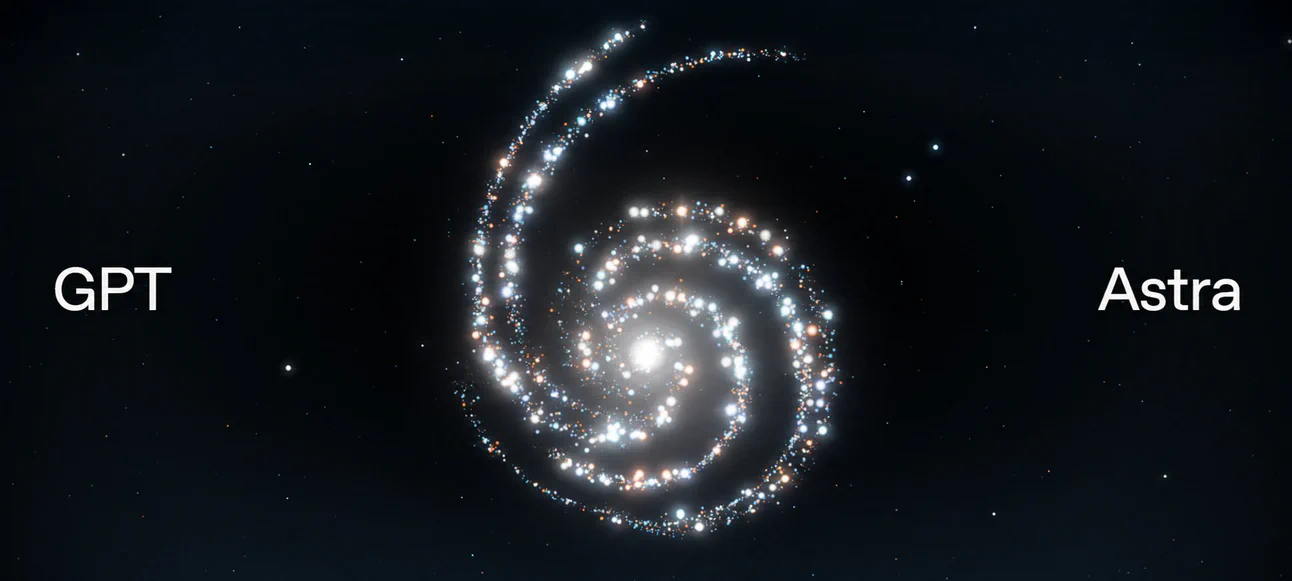
According to OpenAI, it was the first of their models to reach the “critical” cybersecurity level. They said more than 100 thousand NVIDIA Blackwell GPUs were used to train Astra.
On the benchmarks, it hit 100% on ExploitBench (!!) and 99.9% on ARC-AGI-3 (!!!). That ARC-AGI-3 is the one that surprised me the most. For those who don’t know it, they’re logical and visual puzzles, which tend to be complex for AI models. The best ones so far were GPT-5.6 Sol (7.8%) and Claude Opus 5 (30.2%) (Fable and Mythos weren’t tested, because they retain data for 30 days, and the folks at the ARC Prize Foundation didn’t want to risk a leak).
Another big focus for them was “computer use”, meaning the model visually accessing your computer, moving the mouse, clicking on things, etc. On that, the coolest thing was a bunch of people testing how well it models and renders things using Blender over on Xwitter.
Astra also has an interesting architecture detail, which Sebastian Raschka laid out in an excellent article (link below). According to him, Astra uses a “looped transformers” architecture (also called “recurrent depth”). Instead of processing the information just once in each layer of the neural network and moving on until the end, the model reprocesses the same block of layers several times.
Because of that, since this reprocessing happens “hidden”, outside the “chain of thought” that you can read, it’s harder to monitor how the model arrived at an answer, and it can also make interpretability harder. Jakub Pachocki, OpenAI’s chief scientist, went on Xwitter to say this didn’t make the model’s alignment worse (and that it’s actually the most aligned of all the ones they’ve released), and that it remains a priority.
There was also Greg Brockman (OpenAI’s President) and Jensen Huang (NVIDIA’s CEO) posting that “we’ve reached AGI”. And that’s where it turns into more of a philosophical talk than anything else. Since there’s no exact definition of what AGI is, I say that “AGI is whatever your heart says it is”. It’s a very marketing-ish term, and I think it’s a bit too strong for a model that still gets simple tasks wrong every now and then.
Just to have some fun, I ran my benchmark of generating, from scratch, a visually impressive space exploration game on GPT-6 Astra (Ultra effort). It took ~52 minutes, 8.5M input tokens, 92k output tokens, and generated this little game that you can see and play (!) at the link below. I thought it was really beautiful, same level as Fable (or even better in some points), WAAAY better than GPT-5.6 Sol, but it was less careful than Fable in some aspects, like the fact that it didn’t think of adding a soundtrack to get into the vibe.
Anyway, a great launch from OpenAI, and they’re back in the game!
My space exploration game generated by GPT-6 Astra (Ultra effort): https://space-discoverer-bench.netlify.app
Raschka’s article on the GPT-6 Astra architecture: https://magazine.sebastianraschka.com/p/gpt-6-astra-looped-transformers-and