Google discovers a prompt engineering trick to improve LLM answers
Published on
An amazing new AI paper just came out that you need to read. An amazing new AI paper just came out that you need to read. An amazing new AI paper just came out that you need to read. 😅
Jokes aside, a paper from the Google Research folks came out in December 2025, but its insight is so interesting and simple that I thought it was worth bringing to you.
The paper is called “Prompt Repetition Improves Non-Reasoning LLMs”. Basically, they found that if you take your prompt and simply paste it twice in a row in the same message (something like the joke I made at the start of this post), language models get a performance boost when they’re not using reasoning mode.
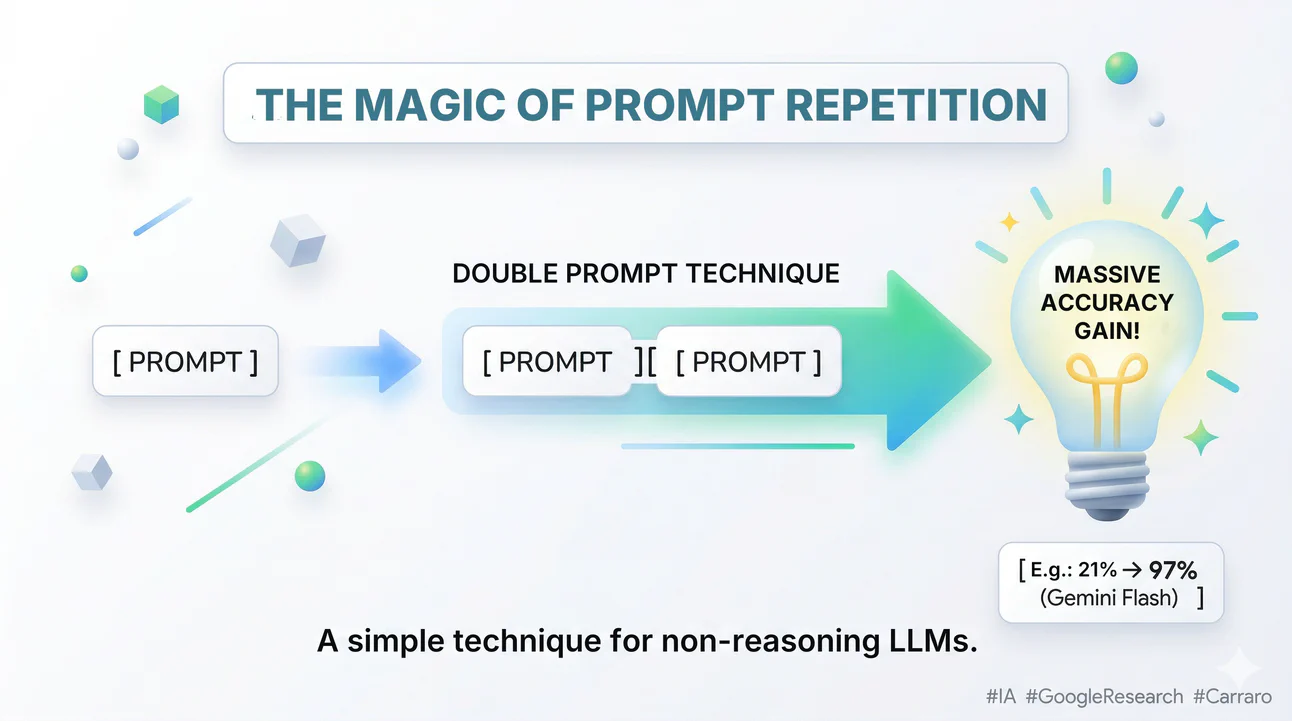
And why on earth does that work? The Google researchers concluded that, since LLMs are trained reading things in causal order, the tokens from the past can’t “see” the tokens from the future. Repeating the whole prompt fixes that, letting every piece of the text pay attention to all the rest of the text itself.
The benchmark results are VERY impressive. They tested this on 7 giant models from the market, like Gemini 2.0 Flash, GPT-4o, Claude 3.7 Sonnet, Deepseek V3, etc., and this repetition technique won in 47 out of 70 tests against the normal prompt, with ZERO losses.
In fact, in one of the tests focused on retrieving information, called NameIndex, the accuracy of Gemini 2.0 Flash-Lite (a tiny model from Google DeepMind) jumped from 21.33% to an absurd 97.33% just by repeating the question in the prompt!
And since this extra repetition happens in the prefill phase (which is parallelized), it practically doesn’t increase response latency, nor does it change the size or format of the final generation. It’s literally a free performance gain.
It’s worth noting that if you’re asking the model to think step by step or using a reasoning model, the gain is neutral or irrelevant. That’s because reasoning models usually already learn on their own to repeat parts of the user’s request right at the start of the chain of thought.
They also tested repeating the prompt 3 times, and in some tests the results were even better than repeating it just twice.
I see this technique as especially useful for working with SLMs (Small Language Models), which are usually less capable, and this “dumb” Prompt Engineering can give a nice boost to performance.
It’s a silly technique, but it shows how much we still have to discover about getting the best out of these models.