FlexOlmo: Federated Learning for LLMs?
Published on
Another super interesting paper that I explained in the last episode of IA Sob Controle was FlexOlmo, from my new favorite, Ai2 (@allen_ai). Their idea is something a lot of people had been wondering about: what if it were possible to train an AI model with data from several companies, without any of them having to share their sensitive data (something like Federated Learning for LLMs)?
You’ve probably noticed in AI models like Gemini, ChatGPT, Claude, etc., that every now and then they say something like: “My knowledge base only goes up to August 2024 (for example)”. That happens because, to train them, the companies collect all the datasets they’re going to use, and the training is done with everything at once. To add more information to the model’s intrinsic “knowledge”, you’d have to do a fine-tuning, which is a pretty costly process.
As a consequence, it’s also not really possible to remove a specific dataset from the model (you can try, but there’s no guarantee either that it’s completely eliminated or that it won’t affect the model’s quality on other tasks). That’s sometimes a dealbreaker for industries with regulated or proprietary data (healthcare, finance, law, etc.).
That’s exactly the problem they set out to tackle. The trick behind FlexOlmo is to use a “Mixture of Experts” (MoE) architecture, but in a different way (kind of a mix of Meta’s Branch-Train-Mix with a freezing mechanism from MoE-LlaVA).
They start with a public, open-source “base” model, in this case, OLMo. The companies (let’s imagine “Carraro Hospital” and the AI company “var X”) take this model and fine-tune this base model separately and locally, only with their private data, never sharing that data with anyone, resulting in two “expert” models, one in medicine and the other in AI code. A router is also trained, to know what that expert’s specialty is.
Afterward, those “expert” versions can be combined, creating a final model that benefits from everyone’s knowledge. This works because of the MoE architecture and the router.
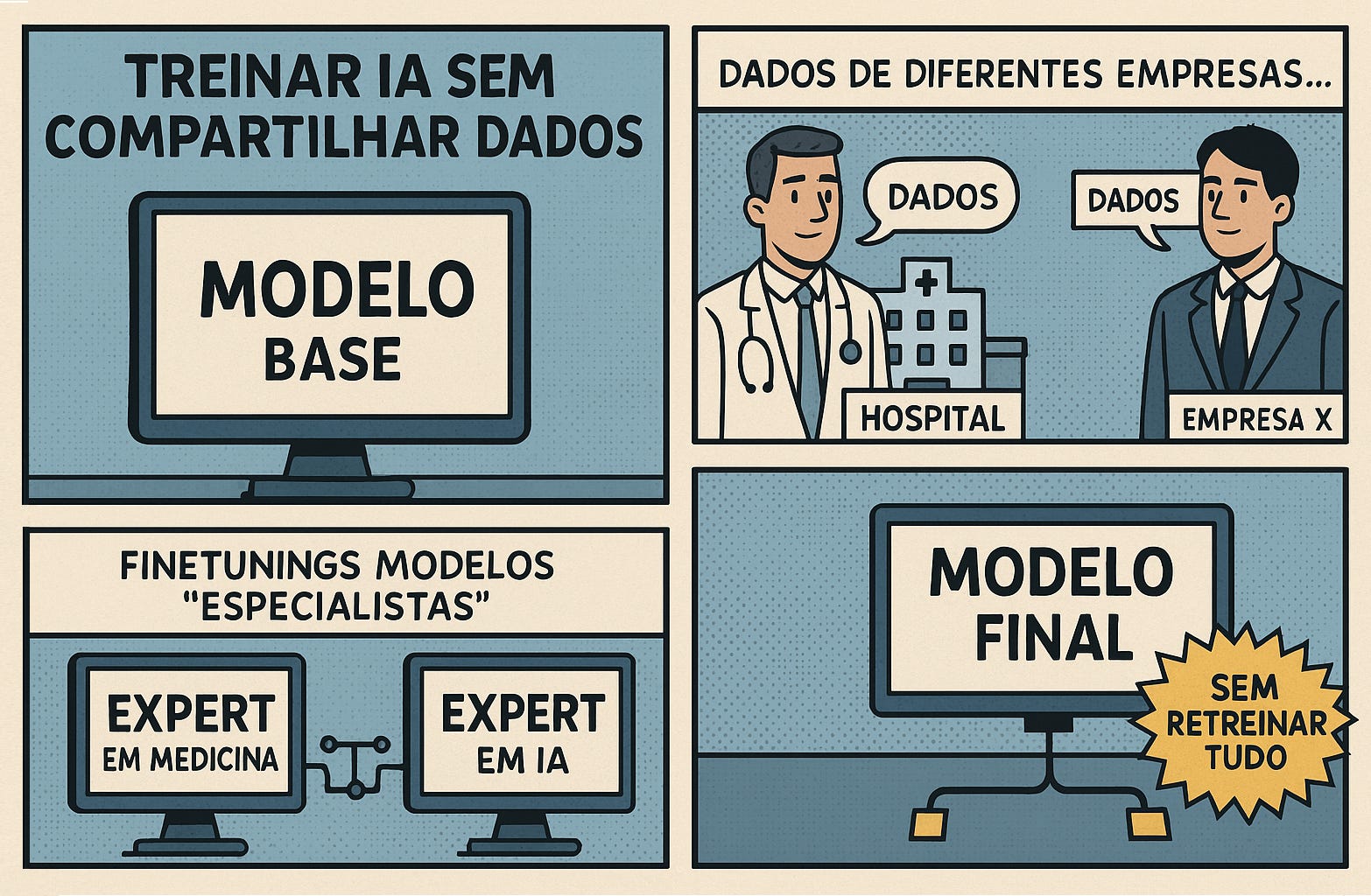
The part I found most impressive is that, at any moment, you can “plug” or “unplug” an expert. For example, if the data license of the “var X” company expires, you can simply remove that expert from the final model, at no cost and without having to retrain everything from scratch, and with minimal loss in the model’s overall quality.
The paper shows that this “combined” approach beats previous model-merging methods by more than 10% and achieves a 41% improvement over the OLMo base model.
In practice, this could unlock an immense amount of high-quality data that today is “locked away” because of privacy concerns. I found it a super elegant solution (and one that could avoid future lawsuits, like the ones we’ve been seeing).
Here’s the link to the paper!