Einstein, Douglas Adams, Arrival, and Scientific AI
Published on
(Translation to English of my original post, written in Brazilian Portuguese)
Lately, my reading on the subway and before bed has been “Story of Your Life”, the Ted Chiang short story that inspired “Arrival”, one of my favorite movies because it brings together science fiction, linguistics, and communication between different species. And I had to stop before the end to write this post, because I inevitably started thinking about a very strong connection to a discussion we’ve been having about AI in science.
Because apparently that’s what happens when you work in this field, where even a quiet read turns into a philosophical benchmark. Rest is for people who haven’t opened arXiv today.
By the way, let me make this clear right now: THIS POST CONTAINS SPOILERS. So if you’ve never seen the movie, get your act together, set aside two hours tonight, and come back to read this tomorrow, wondering how you managed to spend years of your life without seeing this Denis Villeneuve masterpiece.
Back to what matters: the central question in the story and the movie isn’t just about communicating with aliens. It’s about the whole idea that language, causality, and the way you represent the world can change how you think about it. The language of the heptapods (the aliens in the movie) isn’t just a different code for saying the same things. It carries a different structure of thought and perception.
And that reminded me of a discussion that’s been coming up a lot lately: the idea of creating AIs capable of making scientific discoveries. Not just answering difficult questions or suggesting hypotheses for humans to test later, but actually discovering something new. New science.
Recently, Demis Hassabis, CEO of Google DeepMind and one of the people I admire most in this whole field, proposed an interesting test to measure whether we’ve actually reached AGI, artificial general intelligence that could do everything a human expert can.
The Einstein Test
Hassabis’s idea went something like this: train an AI with a knowledge cutoff of 1911 and see whether it could propose general relativity, as Einstein did in 1915. It’s an elegant idea, isn’t it? You freeze the scientific world at a particular year, strip the AI of any explicit knowledge of Einstein, relativity, quantum mechanics, and modern physics, hand it the problems of the time, and say, “Go on, be a genius”.
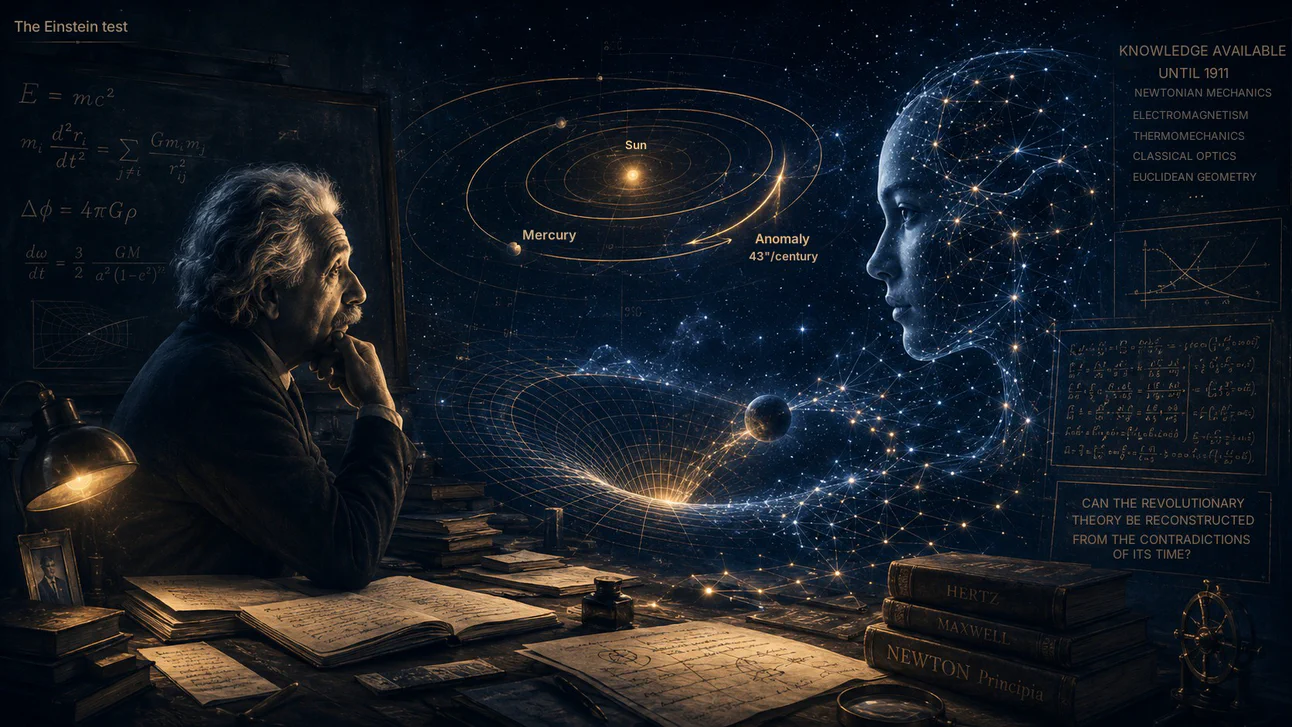
That gets us away from today’s whole benchmark circus, where a model gets multiple-choice questions right, solves puzzles, and passes the bar exam, yet still sometimes stumbles over a calculation a child could do with an abacus. A GPS with Morgan Freeman’s velvety voice and Yann LeCun’s knowledge of AI that nevertheless steers your self-driving car toward a cliff is still a product problem, let’s put it that way.
Proposing relativity “from scratch” (or from the same starting point Einstein had in 1911) is a different kind of yardstick. You’re not asking the model, “Do you know the answer to this question?”. It’s closer to: “Can you build a new way of looking at the world from the contradictions available in your time?”.
And that seems fair, doesn’t it? Einstein didn’t have a PDF called “general_relativity_final_v3.pdf”. He had conceptual contradictions (like Mercury’s orbit not quite adding up), experimental data, mathematics, physical intuition, and an absurd ability to ask strange questions.
And that brings us to the point where I started connecting a few dots. Maybe the challenge isn’t just arriving at the right answer, but knowing which question needs to be asked.
Because a simplified version of this test could become just another answer-finding problem: you give the model a list of observations, point out the inconsistencies in classical physics, and ask which assumption should be abandoned. That might be difficult, but it’s still a game where you’re guiding the AI down a path you’ve already traveled. It could end up falling into the trap of circular reasoning (with the answer already sort of hidden inside the question).
The actual process of creating new science is much messier. Before looking for answers, you need to notice that there really is a question. Before resolving a contradiction, you need to decide that the contradiction matters. This part is less about “answering” and more about “framing”.
Interestingly, someone has already put this test into practice. In a project called “Machina Mirabilis”, researcher Michael Hla trained a model from scratch using only text published before 1900 (around 22 billion “clean” tokens), and then threw at it the same experimental observations that had puzzled scientists at the time. Hla himself is honest about the experiment and says the model is too small to really reason, but that it showed flashes of intuition.
For example, when presented with data on the photoelectric effect, the model insisted that light couldn’t be continuous, that it must be made up of separate parts with different frequencies. That comes close to one of the most important shifts in physics at the time: the idea that light isn’t a continuous flow, but is made up of little packets of energy (Physicists, please don’t kill me for the simplification). This idea began with Planck around 1900, when he realized that energy had to come “in pieces” for the math to actually work out. Einstein took the idea further in 1905 and used precisely this notion of “packets of light” to explain the photoelectric effect (which is what won him the Nobel Prize).
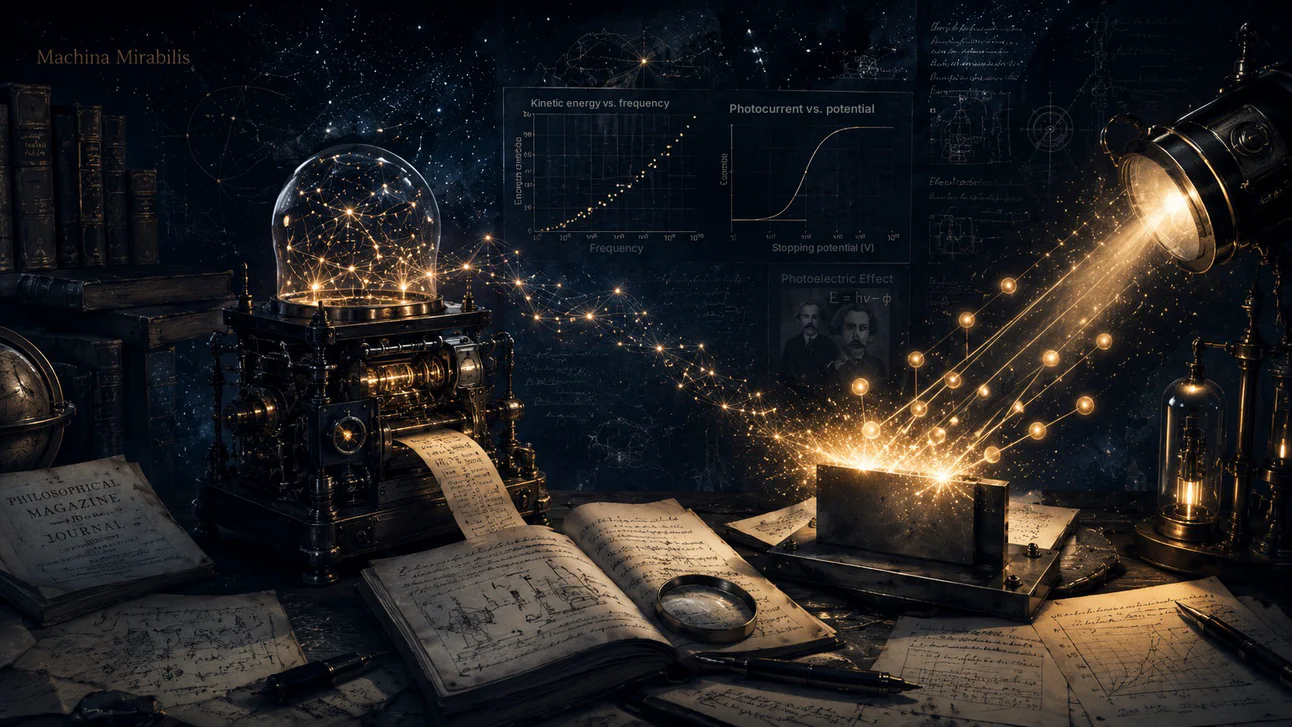
In other words, the little model trained only on pre-1900 text was stumbling onto the right frontier. But coming back to the point of this post, the interesting part is where the bottleneck was. When the little model received the right observation, it could head more or less in the right direction. The really difficult part was the step before that: deciding, out of all that material, what actually deserved to become a question. Those “flashes of intuition” only appeared because a human had already selected the experiment and pointed the model toward it. The circular reasoning I mentioned earlier.
The Answer Is 42
And this is where the clearest connection emerged for me (and I imagine for you too, dear reader, if you’re as much of a nerd as I am). This idea of “knowing what the question is” really reminded me of Douglas Adams’s “The Hitchhiker’s Guide to the Galaxy”. For anyone who hasn’t read it, a civilization in the book builds a supercomputer to discover “the answer to the ultimate question of life, the universe, and everything”.
After spending 7.5 million years thinking about the problem, and you could even draw a connection to LLM reasoning here, the supercomputer finally comes back with a result: “The answer is 42”.
The problem, of course, is that nobody knew what the question was.
This joke works so well because it’s absurd and, at the same time, very precise. Having an answer doesn’t mean understanding the problem. Having an intelligence capable of spitting out some grand conclusion doesn’t solve much if we don’t know what to ask.
And this is where everything I’ve brought up so far comes together. We want an AI that discovers something on the level of “the next relativity,” which could be a breakthrough involving dark matter, dark energy, a cure for cancer, or any other problem at the frontier of science. But underneath the solution to any of these problems, there are many other capabilities these systems need to have.
Some of them are already close to what today’s LLMs can do. Others require something much deeper, like scientific agency, world models that can predict causality, interaction with real, physical experiments, long-term memory, the ability to discard hypotheses, and a less passive, more proactive relationship with all the information that AI will have (whether stored in its weights or retrieved from the internet through a harness).
The Language That Changes Thought
Returning to “Story of Your Life” and the movie “Arrival”, language in these works isn’t just a means of communication. It changes the kinds of thought available to a person or being. After learning the heptapods’ language, the protagonist (played by Amy Adams in the movie) gains access to another way of organizing her perception of how she interacts with the world, where past, present, and future blend together, and everything can be seen and experienced simultaneously.
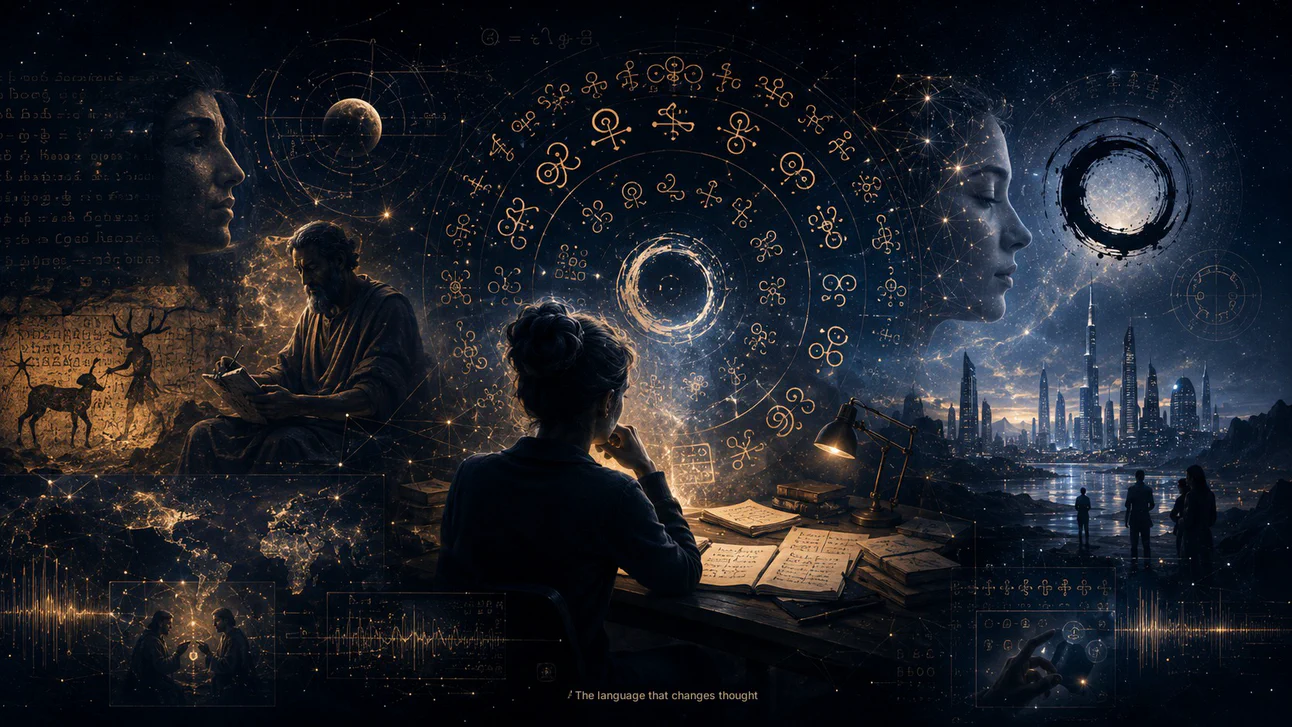
There’s a specific part of the story, not explored much in the movie, that makes this discussion even better. The physicist Gary (played by Jeremy Renner in the movie), notices that whenever the humans show the heptapods a physics or mathematics equation, the heptapods always respond with their own physics’ version of the same problem. But when the humans ask open-ended questions like “What else do you know?” or “What new laws of physics do you already know about?” the heptapods don’t answer. Whether that’s because of a lack of understanding or, as I believe, because they don’t want to alter humanity’s evolution, as in Star Trek. They don’t hand over any new knowledge for free beyond their language.
That’s a powerful insight. The humans can only obtain certain answers when they already know enough to formulate the question. Or, at least, when they already have a conceptual framework that makes it possible to ask for that answer.
Connecting this to the discussion about AI, we might think that perhaps AI can’t “ask itself” about what’s compressed in its own weights. Or perhaps even that isn’t right, and the real problem is that nobody in the room (neither us nor the model) yet has the language needed to make the next question askable. In this analogy, the heptapods are neither the AI nor us. They represent a form of knowledge we haven’t yet learned how to ask for.
And I think this could be an interesting analogy for science. In 1915, Einstein didn’t just “answer” a question that was on the blackboard. He changed the way the question could be asked, making space and time the very dynamics of the problem.
Maybe our next major scientific discoveries will require something like learning a new conceptual language, like the heptapods’. Not in some mystical, alien sense, but in a genuinely technical one: new representations, new abstractions, new ways of compressing or perceiving the world.
And that’s where I think Demis Hassabis’s Einstein test for AGI might change a little. Perhaps the right question isn’t just, “Would a model trained on knowledge up to 1911 arrive at relativity?” but rather, “Would a model trained on knowledge up to 1911 be able to recognize that the foundations of how we understood the physics of space, time, and gravity needed to change?” The difference between those two questions is enormous. The first asks for an answer. The second asks for a reformulation of the question and the problem itself.
A truly powerful scientific AI should be able to say things like:
- “This hypothesis seems poorly formulated.”
- “These data suggest that this might not be the main question.”
- “You’re trying to explain X, but the relevant anomaly is in Y.”
- “This problem seems to call for a new variable or representation.”
- “This body of literature is stuck in a false dichotomy.”
And that’s much harder than answering “42”. And much more useful.
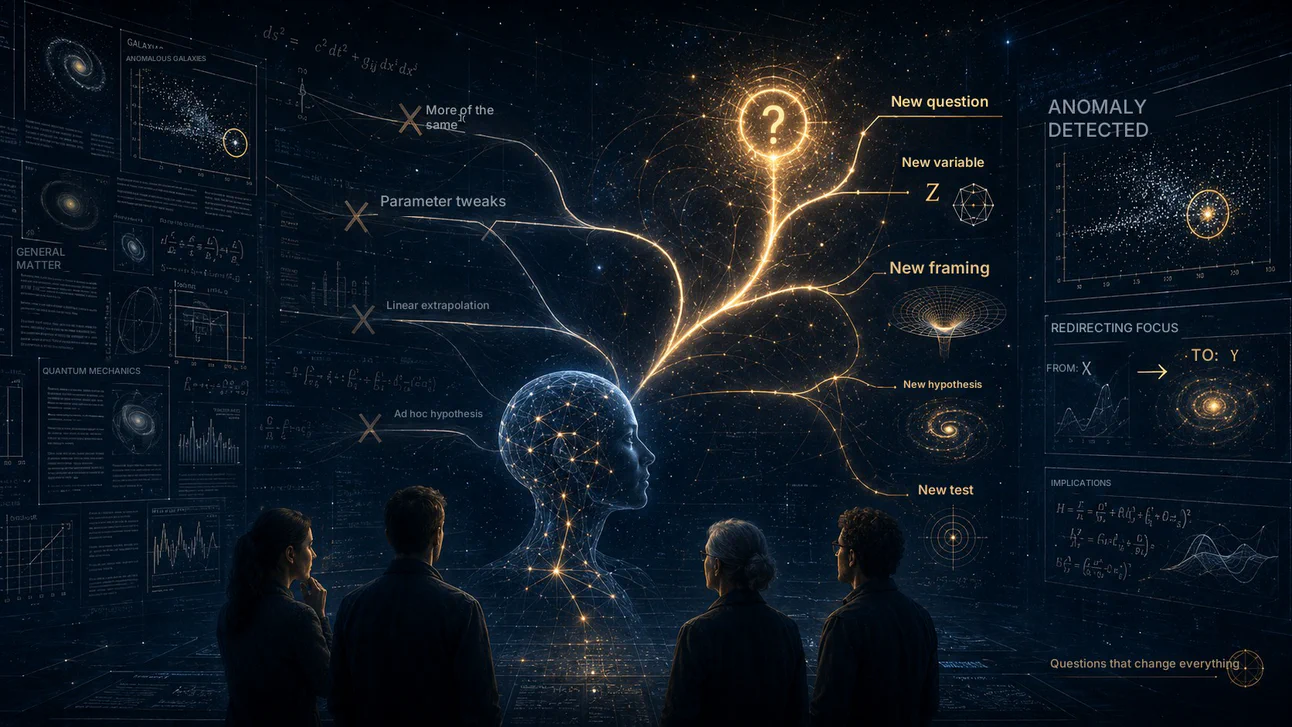
Instead of just asking whether an AI could derive relativity from pre-1911 data, we could ask whether it can take part in the process that comes before: identifying which anomalies deserve attention, proposing different ways of framing the physics, deciding which experiments would help, abandoning unproductive paths, explaining why one scientific question is more fertile than another, and so on.
And Hassabis himself has sort of already acknowledged this. He recently commented that an AI solving a famous problem like the Riemann hypothesis would be spectacular (and it really would), but that it would be much better if it could propose a cutting-edge mathematical problem. In other words: formulating a good question is harder than answering it. It’s almost the same idea I drew from Ted Chiang’s story and the heptapods, just viewed through mathematics.
Einstein or Douglas Adams?
I really liked Hassabis’s idea when I saw the video, because it raises the level of the conversation, takes the AGI discussion out of benchmark territory, and moves it into the realm of actually creating knowledge (and congratulations if you’ve made it this far into this loooong philosophical discussion).
In the end, maybe we’re less close to Einstein and more close to Douglas Adams, building increasingly powerful systems to find answers while the really difficult part is still figuring out what we should be asking. And if AI one day helps us do that, perhaps that will be a much more interesting sign of intelligence than simply getting the final number right.
Because answers are important. But good questions change the universe in which the answers make sense.