Between Amazement and Indifference: The Age of Accelerated AIs
Published on
You know that feeling when you look at an old photo from just a few years ago and think “wow, things have really changed”? Whether it’s fashion, the phone in our hands, or even our own sense of what was “normal”? It’s a common feeling, but it gets almost absurd when you think about how fast AI has evolved.
I’m not one to write philosophical stuff like this, but I saw a tweet from Sam Altman (CEO of OpenAI) that got me thinking. He commented on how good ChatGPT is today, and said it would be interesting to revisit the late-2022 version, just to get a sense of the jump and of how archaic it would look.
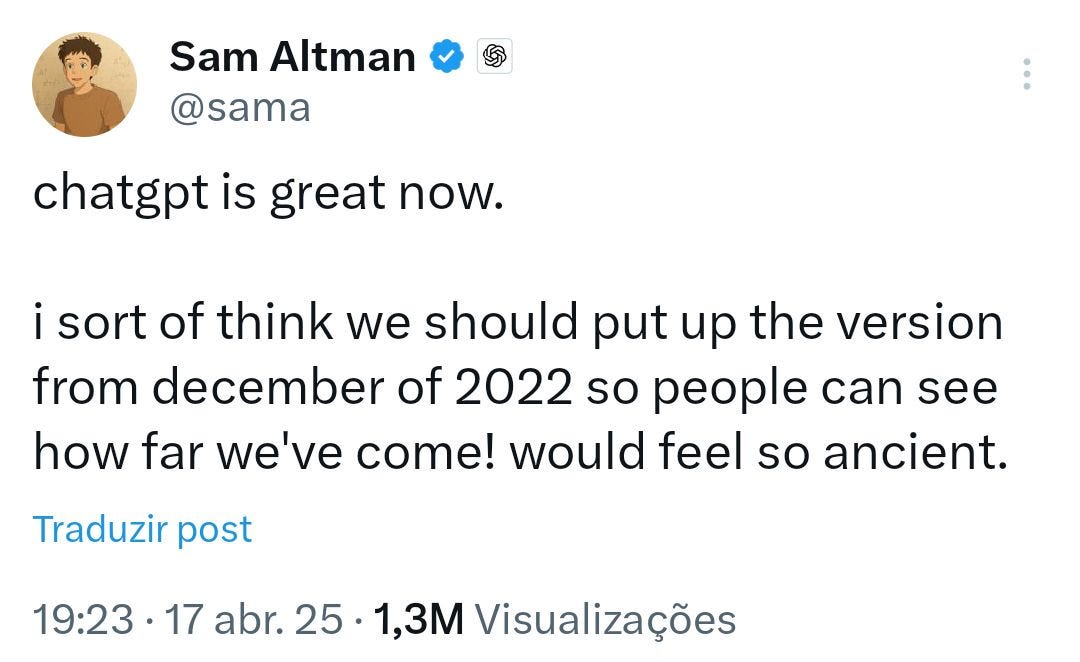
Guys, it’s been only 2 and a half years!! (which, as Marcus Mendes always says, in AI are like dog years and add up to about 15)
Actually, this goes way beyond the simple speed of technology. It touches on something fundamental about our relationship with progress and our own ability to adapt to the new.
What amazed us yesterday, today we’ve absorbed so completely that we don’t even notice it anymore. It became scenery, the new starting point. It’s almost like we’re living on a treadmill of expectations and novelties, where what counts as “impressive” has a shorter and shorter shelf life.
Weird, right?
Could it be that this constant acceleration desensitizes us to the extraordinary?
And here comes the most provocative idea, almost a time paradox: o3, Gemini 2.5 Pro, and Claude 3.7 Sonnet, which are the most advanced and incredible AI models we have today, are the worst AI models we’ll ever have from here on out.
Stop and think about the weight of that. Today’s peak is just the beginning of the next climb. It’s not only about having faster or more efficient tools. It’s about how this reshapes our work, our creativity, the way we solve problems, and even our identity in a world we share with non-biological intelligences that keep getting more capable.
If the “worst” of the near future is already as powerful as our “best” today, what real transformations (not just incremental ones, but maybe even existential ones) can we expect a year from now? And what model will we have in 5 years?
Maybe the biggest challenge isn’t exactly keeping up with the speed of this development (which is already pretty complicated for someone who has a podcast like IA Sob Controle and “has to” be super up to date all the time, imagine for those who don’t have that obligation…), but rather cultivating the depth and the discernment to find our way through this new era.
It’s a feeling similar to something I saw in a stand-up routine years ago about airplanes. We get used to complaining about everything: the seats aren’t very comfortable, they only served a little cookie and water, and we tend to forget that WE’RE IN A METAL CYLINDER IN THE SKY, FLYING LIKE BIRDS AT 900 KM/H, and that only people in the last ~120 years have been able to experience that.
Anyway.
What does all this acceleration stir up in you? Curiosity, worry, excitement? A bit of each?