Anthropic says you're building AI agents the WRONG way
Published on
Anthropic just dropped an article that I think is MANDATORY for anyone who works as a dev or builds AI agents. Basically, it’s them saying: “You’re doing it WRONG!”
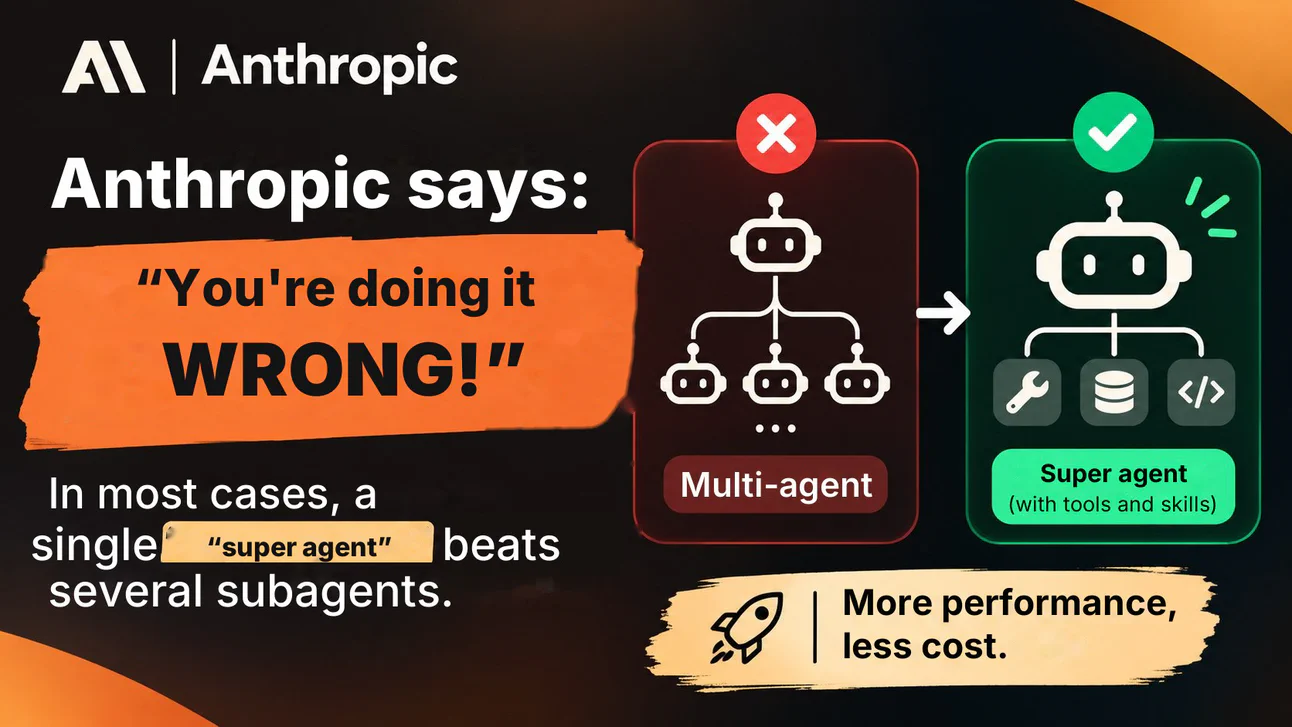
Their Applied AI team ran comparisons across several enterprise deployments, comparing pipelines, and reached the conclusion that, in most cases, a single “super agent” with tools and skills tends to perform better than an architecture full of orchestrated subagents, and can potentially end up MUCH cheaper and faster per task.
By analogy, having lots of agents would be like having a team of human specialists who only talk to each other through reports. That way, each of them loses a little of the project’s original idea, like a briefing that goes through three managers before reaching whoever executes it. In the end, nobody has the full picture, and the result comes out super generic. That’s basically what they said happens inside AI agents.
The article also talks about a very common pattern (and one I’ve seen up close in an automation project), where each team creates its own subagent for its little piece of the problem. Until recently, it was seen as a “proto-best-practice” to have one subagent just to handle refunds, another for product exchanges, another for warranty questions.
The alternative Anthropic recommends is called “progressive disclosure” (the same concept I already explained in my post about Skills). The idea is that the agent only sees short descriptions of the available tools and skills, and only loads the full content when it really needs to use it. With that, you can keep a single agent MUCH leaner, without having to split everything into specialist subagents. Anthropic itself said it used this technique to cut Claude Code’s system prompt by more than 80% (for the most advanced models).
I really like this logic of keeping the whole context inside a single window, so the agent can connect what happened in each previous step, instead of only receiving partial summaries from different subagents.
And of course, this is only possible thanks to the huge improvements in quality and context window of the models we have available today.
Anthropic also makes clear that a pipeline with subagents can still be better when your benchmark says a single agent suffered a performance degradation from too much context, or when several tasks need to be run in parallel, or when there are conflicting instructions in the prompt.
We spent a good while hammering on the idea of “multi-agents for everything”, and now Anthropic itself is publicly saying a classic of classic Software Engineering, which goes “start simple, and only add complexity when there’s data showing it’s necessary”.
At the end of the day, it’s like science, which can change with every new improvement or discovery. We’re using this technology and building it at the same time, changing the tire while the car is moving.
Here’s the link to the article.