AI-bus: a new paradigm for Europe in the global AI market?
Published on
What if Europe created its own “AI-bus” to compete worldwide in the AI race?
This provocation isn’t mine, it comes from a really interesting article I read in the newspaper El País, written by Daniel Crespo (rector of UPC) and Mateo Valero (director of the Barcelona Supercomputing Center, where I’ve been working).
The idea is that, just like Europe came together to create Airbus and break Boeing’s monopoly in the 70s, maybe it’s time to do the same with AI.
For those who don’t remember the story, in the 60s and 70s, Boeing and McDonnell Douglas completely dominated the market, and no European company could stand up to them. That’s when they chose to unite several countries, a consortium between France, Germany, Spain and the UK, where each one built a part of the plane (wings, fuselage, etc.) and the final assembly was done together. It was a super expensive, slow project that many thought would fail, but today Airbus not only competes, it leads the global market, ahead of Boeing itself.
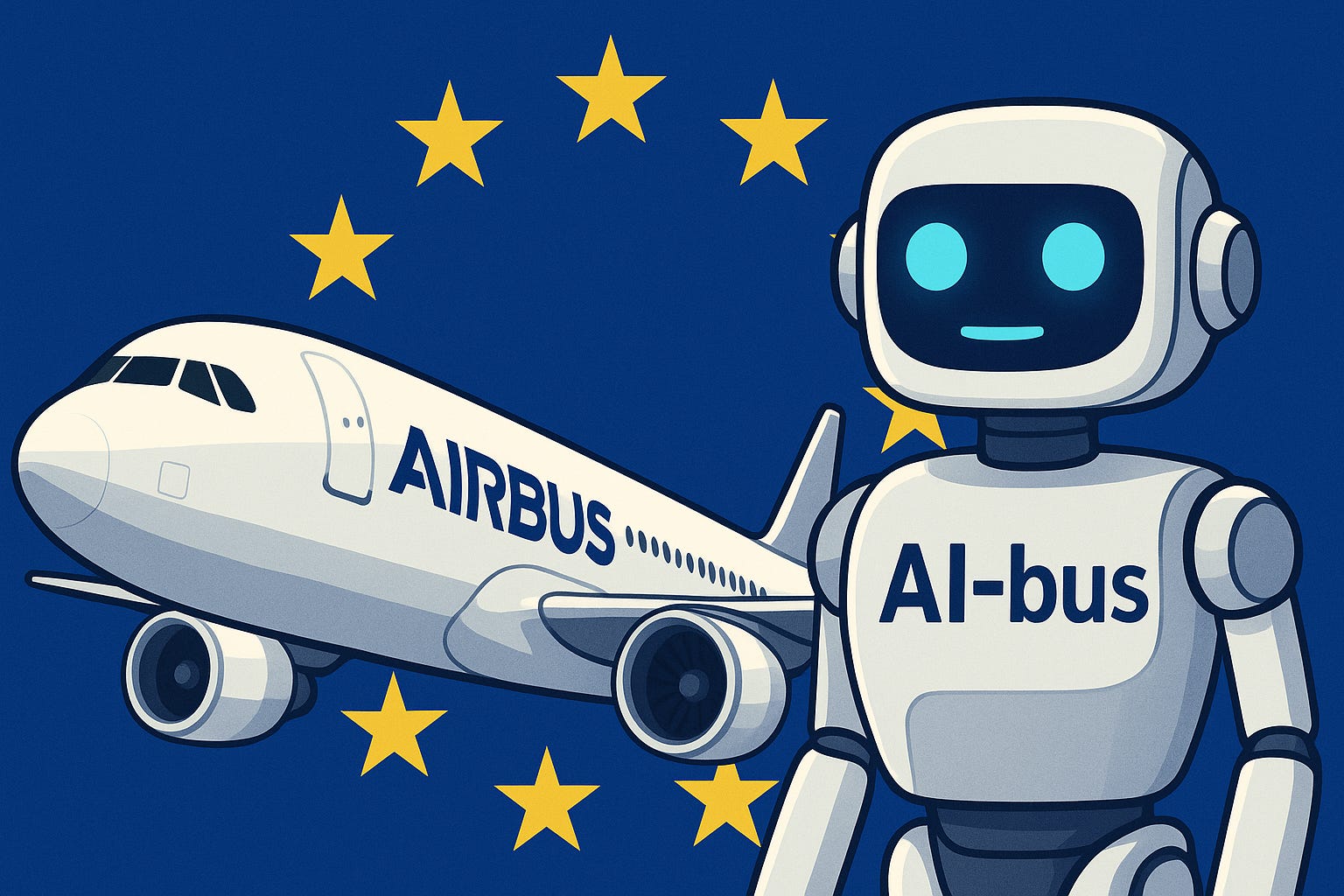
Back to AI, the authors’ argument is that Europe is in a dangerous situation, similar to that time: hardware dependence (hostages of the chips from NVIDIA, Intel, with no bargaining power and vulnerable to restrictions, like the US ones), a delay in development (practically all the most powerful models still come from the US and China), and regulation (they created the EU AI Act, but run the risk of being “referees of a game with no players”).
The article is from 2024, but in July 2025, this discussion is still going strong. We have models from OpenAI and Google getting better and better, China is strong too, but we’re starting to see the beginning of a European reaction.
France, for example, is leading a strong push with Mistral AI, which keeps releasing high-quality open-source models, like the “Magistral” reasoning one, the “Voxtral” audio one, often beating competitors at a lower cost.
On top of that, the European Union announced ambitious plans like the “AI Continent Action Plan”, with “AI Factories” and “Gigafactories” to boost infrastructure and research. It’s not much, but it’s a start.
The question that remains is: what’s the best path for Europe?
The “AI-bus” model: create one or two gigantic companies, maybe with state backing, to develop closed models and compete with OpenAI/Google?
The “Galileo” model: focus on an open ecosystem, strengthening players like Mistral and others, and creating open standards (just like they did with the Galileo GPS), to generate bottom-up innovation?
Personally, I see the second path as having more potential. It seems to fit better with the European DNA of collaboration and can create a strategic advantage by not trying to play the same game as the Americans. Open, high-quality models can speed up adoption and the creation of a rich ecosystem around them.
This is a topic we’ll definitely discuss more on the IA Sob Controle podcast.
Which path do you think is best?
Here’s the link to the article.