AI Against Superbugs
Published on
This week an extremely cool AI paper came out, about AI in biomedicine, on generating entire genomes from scratch.
Researchers from the Arc Institute and Stanford University used the genomics model “Evo” to generate the first complete, functional genomes of a bacteriophage (a type of virus that infects bacteria) from scratch.
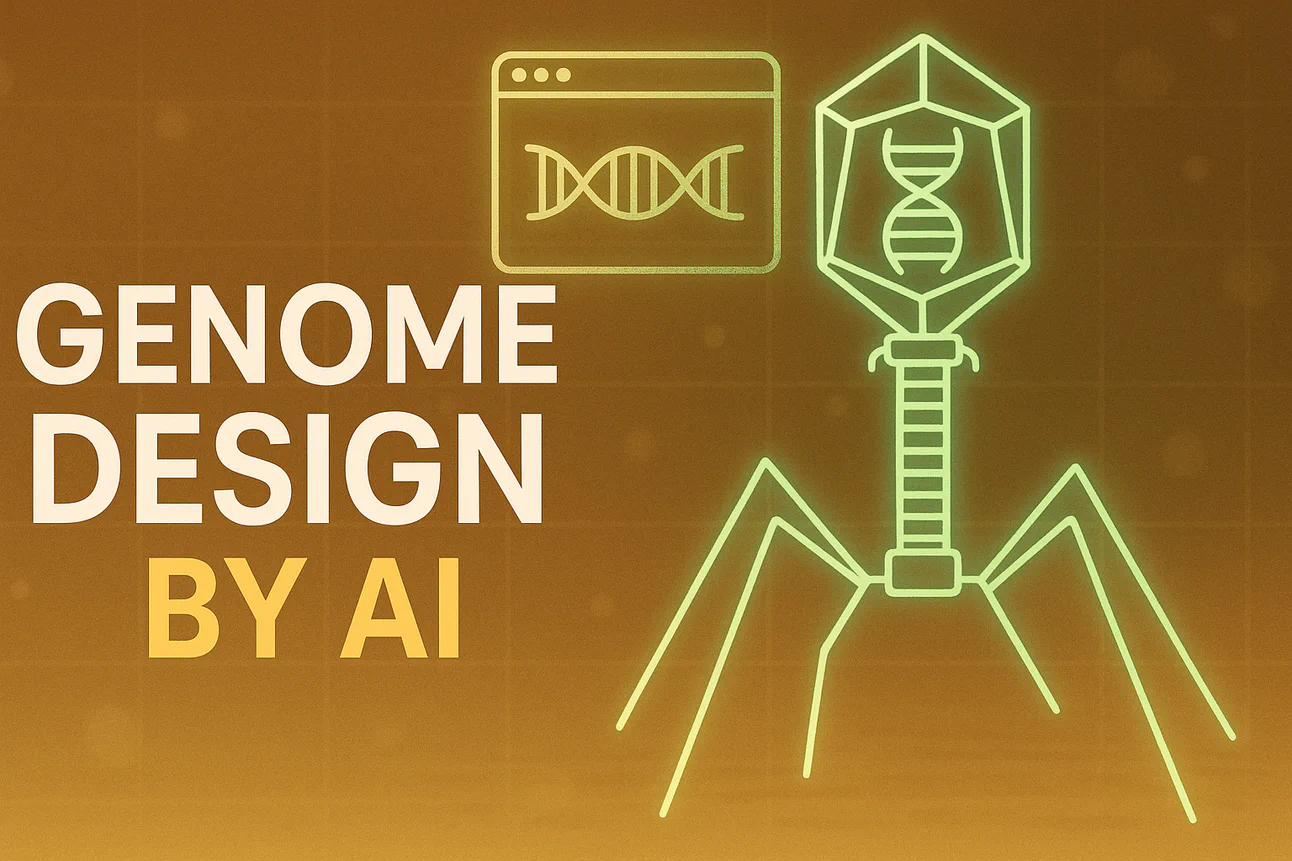
They used the bacteriophage ΦX174 as a base, which was the first complete genome ever sequenced (in 1977) and the first entire genome chemically synthesized (in 2003). Now, in 2025, it was the base for the first genome designed by an AI.
Basically, we started back in the era of “reading” DNA, moved on to the era of “writing”, and now we’ve arrived at the era of “designing”. Generating an entire genome is absurdly more complex than generating a single protein. You have to orchestrate multiple genes and elements that need to work in harmony.
To get there, the team had a few challenges. They created a custom gene annotation pipeline, since the standard tools couldn’t handle ΦX174’s complexity. Then, they heavily fine-tuned the Evo model on a dataset of almost 15 thousand sequences of similar viruses, and developed a high-throughput testing system to validate hundreds of synthetic genomes and see which ones really worked.
As a result of this research, out of 285 generated designs, 16 turned out to be functional bacteriophages. One of them, “Evo-Φ2147”, was so different from its closest natural relative (with 392 mutations) that it could already be considered a new species.
The most impressive thing to me was that one of the synthetic bacteriophages managed to incorporate a protein from a distant relative, something human engineers had already tried to do before and failed.
And you might ask me: “Cool, Fabrício, but how does this affect my life?”. Well, initially, in fighting antibiotic-resistant bacteria.
In the experiment, they created strains of E. coli bacteria (yes, that same one, common in feces) resistant to the common bacteriophage found in nature. As expected, the natural bacteriophage couldn’t do anything, because of that resistance. But a “cocktail” of the AI-generated bacteriophages managed to overcome the bacteria’s resistance in very little time.
In other words, instead of hoping nature has already evolved a bacteriophage/virus that works against a specific bacterium, or that we find one “by luck”, now we can generate hundreds of them in the lab, keep testing, until we find one that works. Or even better, a custom one, that works FOR YOU. This could really revolutionize the way we treat infections.
We’re watching biology become, for real, an engineering discipline, with AI as the main tool. Impressive, right?
Here’s the link to the paper.